
Featured Snippet In the UK, both vertical and horizontal orientations are permitted under BS 7671 regulations, provided the unit remains accessible for maintenance and labelling is clear. Vertical mounting suits compact spaces and aesthetics; horizontal suits wider wall spans. For multi-gang Repenic dimmers, orientation depends on LED de-rating, back box depth (≥25mm minimum), cable routing within electrical safety zones, and multi-way control requirements. Consult a qualified electrician to ensure compliance and optimal performance.
Check: How Can You Control Lights Away From Home Easily?
What Do UK Electrical Regulations Say About Switch Plate Orientation?
UK electrical standards (BS 7671 and IET Wiring Regulations) do not mandate vertical or horizontal orientation for switch plates. However, regulations require that switches remain accessible, clearly labelled, and installed in approved enclosures. Both orientations are compliant provided the installation meets back box depth requirements (≥25mm for modern dimmers) and maintains proper cable routing within electrical safety zones.
The flexibility offered by UK regulations means homeowners and professionals can choose orientation based on aesthetic preference, space constraints, and functional requirements. However, accessibility remains paramount—switches must be reachable without obstruction, and any labelling (particularly for multi-way or smart dimmer setups) must remain visible and legible after installation.
For multi-gang installations, particularly those involving Repenic smart dimmers or dummy dimmers in multi-way configurations, it is essential to work with a qualified electrician. They will ensure that cable routing complies with electrical safety zones, that all connections are secure, and that the orientation chosen does not compromise the integrity of the installation or the performance of no-neutral dimmer technology.
How Do Vertical and Horizontal Orientations Differ Aesthetically and Functionally?
Vertical orientation (screw slots running top-to-bottom) creates a clean, professional appearance and is preferred by many UK electricians for aesthetic consistency. Horizontal orientation (screw slots running left-to-right) suits wider wall spans and can appear more balanced in landscape-oriented spaces. Functionally, vertical mounting often provides better dust control and ergonomic access to controls, while horizontal can reduce visual clutter in compact kitchens or bathrooms.
From an aesthetic standpoint, vertical orientation has become the industry standard in UK installations, particularly for premium finishes like solid brass and stainless steel. This preference stems from several factors: vertical screw alignment creates visual symmetry that complements modern interior design, and it appears more intentional and professional to the eye. When all screw slots in a multi-gang plate are aligned vertically, the overall appearance is cohesive and refined.
Horizontal orientation, by contrast, works well in specific scenarios—particularly in wide, open wall spaces such as feature walls in kitchens or utility areas where the plate spans a significant horizontal distance. Horizontal mounting can also reduce the perceived "busyness" of a control panel by spreading visual elements across a wider plane.
Functionally, vertical orientation offers ergonomic advantages. Dust and debris naturally fall away from vertically-oriented screw slots, reducing maintenance over time. Additionally, when reaching for controls on a vertical plate, users experience more natural wrist alignment, particularly in kitchens where multi-gang dimmers control task lighting, accent lighting, and ambient lighting across different zones.
Which Orientation Works Best for Multi-Gang Brass and Steel Dimmers?
For premium finishes like Repenic's solid brass and stainless steel dimmers, vertical orientation is recommended. Vertical mounting enhances the visual impact of metal faceplates, creates uniform aesthetic consistency across multi-gang layouts, and aligns with professional UK installation standards. Horizontal orientation is acceptable but less common for luxury finishes; it suits specific design schemes or spatial constraints.
Repenic's range of multi-gang dimmers—available in solid brass, black steel, and stainless steel—are engineered to deliver premium aesthetics and reliable performance in demanding UK homes. When choosing between vertical and horizontal mounting for these products, consider the following:
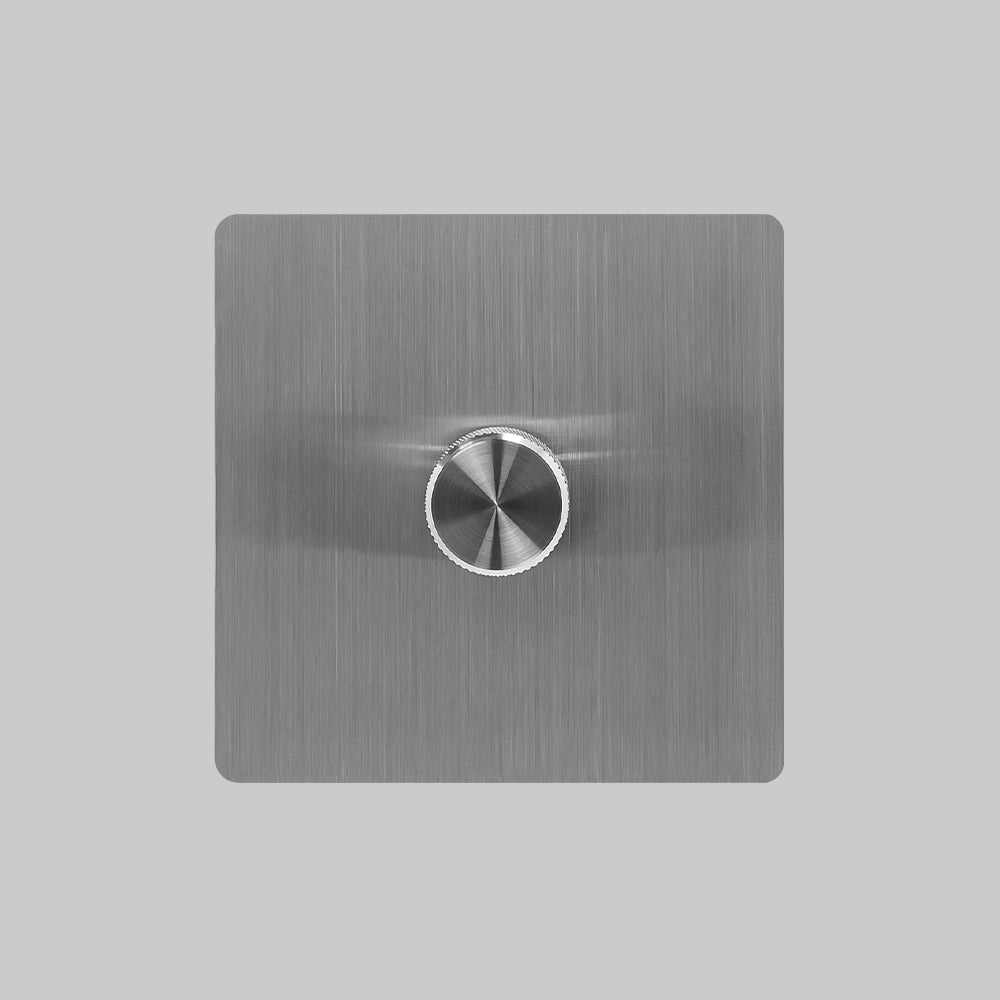
Vertical Orientation Benefits for Metal Dimmers: The solid brass and stainless steel faceplates on Repenic dimmers are designed to catch and reflect light, creating visual depth and sophistication. Vertical mounting amplifies this effect by presenting the faceplate squarely to the viewer, maximizing the visual impact of the knurled metal knobs and brushed finish. In multi-gang configurations—such as a 4-gang setup controlling kitchen zones—vertical alignment creates a unified, gallery-like appearance that elevates the overall interior design.
Horizontal Orientation for Metal Dimmers: While less common, horizontal mounting can work beautifully in specific contexts. For instance, in a wide galley kitchen or a spacious bathroom with a long vanity, horizontal orientation can distribute control points across a wider plane, creating visual balance. However, this approach requires careful consideration of the faceplate finish and the surrounding décor to avoid appearing disjointed.
Regardless of orientation, Repenic dimmers are engineered to fit standard UK back boxes (≥25mm depth) and maintain consistent performance. The no-neutral wiring design means orientation does not affect electrical functionality—only aesthetics and user ergonomics influence the choice.
Why Does LED De-Rating Matter When Mounting Dimmers Vertically or Horizontally?
LED de-rating—the reduction in maximum load capacity per dimmer in multi-gang setups—is a thermal management principle unrelated to physical orientation. However, orientation affects heat dissipation efficiency. Vertical mounting typically offers better natural convection cooling, while horizontal mounting may concentrate heat in localized areas. For Repenic dimmers controlling multiple LED zones, understanding de-rating ensures safe, flicker-free operation regardless of orientation.
LED de-rating is critical in multi-gang dimmer installations. Unlike traditional incandescent or halogen loads, LEDs generate minimal heat, but the dimmer electronics themselves produce heat that must dissipate efficiently. When multiple Repenic dimmers are stacked in a single back box—particularly in 3-gang or 4-gang configurations—each dimmer's maximum load capacity is reduced to prevent thermal buildup.
| Configuration | Repenic RD-250 Load (Dimmable LED R,C) | Repenic RD-400 Load (Dimmable LED R,C) |
|---|---|---|
| 1-Gang (Single) | 250W | 400W |
| 2-Gang | 212W per dimmer | 340W per dimmer |
| 3-Gang | 175W per dimmer | 280W per dimmer |
| 4-Gang | 125W per dimmer | 200W per dimmer |
As the table above demonstrates, a 4-gang installation with Repenic RD-250 dimmers reduces each dimmer to 125W maximum load—half the single-gang capacity. This de-rating is necessary to maintain safe operating temperatures and ensure reliable dimming performance without flickering or thermal shutdown.
Orientation influences thermal management indirectly. Vertical orientation naturally promotes upward convection of warm air, which can improve heat dissipation in tightly-packed multi-gang back boxes. Horizontal orientation may trap warm air, requiring careful cable routing and spacing to maintain adequate airflow. Neither orientation eliminates the need for de-rating calculations; rather, orientation should be considered alongside thermal design when planning multi-gang LED dimmer installations.
When specifying Repenic dimmers for a 4-gang kitchen renovation controlling multiple LED zones, a qualified electrician will calculate total LED load across all zones, apply appropriate de-rating factors, and ensure each dimmer operates within its rated capacity. This process is orientation-independent but essential for long-term reliability and performance.
Can You Install No-Neutral Dimmers in Both Orientations Without Issues?
Yes. Repenic no-neutral dimmers (including smart dimmers and standard dimmers) function identically in vertical or horizontal orientations. No-neutral technology relies on capacitive coupling through the load, not on physical orientation. Both orientations maintain the same electrical safety, performance, and compatibility with UK back boxes (≥25mm). Orientation choice is purely aesthetic and ergonomic.
One of Repenic's key innovations is no-neutral dimmer technology, which eliminates the need for a separate neutral wire—a significant advantage in older UK homes where neutral wiring to switch locations is limited or absent. This technology works through capacitive coupling with the connected LED load, delivering reliable trailing-edge or leading-edge dimming without requiring a neutral conductor.
The beauty of no-neutral design is that it is orientation-agnostic. Whether a Repenic dimmer is mounted vertically or horizontally, the internal electronic circuitry functions identically. The dimmer detects the connected load (whether dimmable LEDs, halogens, or incandescent bulbs), automatically adjusts dimming characteristics, and delivers smooth 0-100% dimming without flickering or buzzing—regardless of how the faceplate is oriented on the wall.
This flexibility is particularly valuable in multi-gang setups where space constraints or aesthetic preferences might favour horizontal mounting. A homeowner can confidently choose horizontal orientation for a 4-gang Repenic dimmer installation in a kitchen, knowing that no-neutral performance, energy monitoring (on smart models), and multi-way control capabilities remain unaffected.
However, cable routing within the back box does require attention. Whether mounting vertically or horizontally, cables must be neatly organized, routed within electrical safety zones, and secured to prevent strain on terminals. A qualified electrician will ensure proper cable management regardless of orientation, maintaining the integrity of the no-neutral connection and the dimmer's long-term reliability.
How Do Back Box Depth and Cable Routing Affect Your Orientation Choice?
Repenic dimmers require back box depth ≥25mm to accommodate the electronic module and allow safe cable routing. Orientation affects how cables are routed within the box. Vertical mounting often allows cables to route upward or downward; horizontal mounting may require side routing. Both are compliant if cables remain within electrical safety zones and are properly secured. Consult an electrician to optimize routing for your specific installation.
UK back boxes come in various depths, typically ranging from 16mm (shallow) to 35mm (deep). Modern dimmers, particularly those with no-neutral technology and advanced dimming electronics, require adequate internal space for the electronic module, terminal blocks, and cable routing. Repenic dimmers are engineered to fit standard UK back boxes with ≥25mm depth, providing sufficient clearance for safe installation.
Orientation influences cable routing strategy. In a vertical orientation, incoming and outgoing cables can often be routed upward into the back box from the conduit below, or downward from above, allowing cables to run parallel to the mounting yoke of the dimmer. This arrangement is intuitive and commonly used in UK installations.
In horizontal orientation, cables may need to route from the sides of the back box, requiring more careful planning to avoid strain on the dimmer's terminal blocks. However, this is entirely feasible with proper cable management—using cable clips, cable ties, and careful routing within electrical safety zones to prevent sharp bends or tension on connections.
Electrical safety zones are designated areas within the wall where cables can safely run without risk of damage from drilling, nailing, or other wall penetrations. In the UK, these zones are typically defined vertically above and below switch positions, and horizontally around outlet locations. A qualified electrician will ensure that cables are routed within these zones regardless of dimmer orientation, protecting the installation from future damage and maintaining compliance with BS 7671.
What Are the Best Practices for Multi-Way Dimmer Setups in Vertical vs Horizontal Layouts?
Check: Which 4 Gang Dimmer Switch is Best for Your UK Home? A Complete Buying Guide
For multi-way dimmer setups, maintain consistent orientation across all switch locations for visual uniformity and ease of maintenance. Repenic offers matching dummy dimmers in brass, steel, and stainless steel that pair seamlessly with primary dimmers in both vertical and horizontal layouts. Vertical orientation is recommended for multi-way installations to create a professional, cohesive appearance across multiple wall locations.
Multi-way dimmer installations—where lights are controlled from two or more locations—require careful coordination of orientation across all switch points. In a typical kitchen renovation, for example, you might install a primary Repenic smart dimmer at the main entrance and dummy dimmers (or additional smart dimmers) at secondary locations such as the island or near the sink.
Maintaining consistent orientation across all switch locations creates visual harmony and professional appearance. If the primary dimmer is mounted vertically, all companion dummy dimmers should also be vertical. This consistency signals intentional, professional installation and enhances the overall aesthetic of the space.
Repenic's dummy dimmers in solid brass, black steel, and stainless steel are designed to match the aesthetic of primary dimmers exactly. The knurled metal knobs, brushed finishes, and proportions are identical, ensuring seamless visual integration whether mounted vertically or horizontally. When paired with Repenic's primary dimmers (available in 1-gang, 2-gang, 3-gang, and 4-gang configurations), dummy dimmers create unified multi-location lighting control that looks intentional and premium.
From a functional perspective, vertical orientation in multi-way setups offers ergonomic advantages. Users become accustomed to reaching for controls in a consistent orientation, and the muscle memory associated with vertical screw alignment becomes intuitive. In a 4-gang kitchen setup where three locations control the same light zone, vertical consistency reinforces this intuitive interaction.
Does Orientation Impact Repenic Smart Dimmer Compatibility and Performance?
No. Repenic smart dimmers (Zigbee 3.0 enabled) perform identically in vertical or horizontal orientations. Zigbee connectivity, energy monitoring, OTA upgrades, and dimming modes (trailing/leading edge) are unaffected by physical mounting orientation. Orientation is purely an aesthetic and ergonomic choice; all smart features function reliably regardless of how the dimmer is positioned on the wall.
Repenic's smart dimmers leverage Zigbee 3.0 protocol to deliver advanced features including real-time energy monitoring, over-the-air firmware updates, programmable brightness levels, boost mode for low-level illumination, and seamless integration with platforms like Homey and Hubitat. These capabilities rely on wireless communication and internal electronics, not on physical orientation.
Whether a Repenic smart dimmer is mounted vertically or horizontally, the Zigbee radio maintains consistent signal strength and connectivity. The internal chipset processes dimming commands, energy data, and firmware updates identically. The user experience—controlling lights via smartphone app, voice commands, or automation routines—remains unchanged.
This orientation-independence is particularly valuable for renovators designing complex smart home ecosystems. A homeowner can optimize multi-gang layout for aesthetics and ergonomics without compromising smart functionality. For instance, if a 4-gang layout in a kitchen benefits aesthetically from horizontal orientation, the smart dimmer's Zigbee performance, energy tracking, and integration with Google Home or other platforms remain fully operational.
Repenic Expert Views: "At Repenic, we've engineered our dimmers to deliver consistent performance regardless of installation orientation. Our no-neutral technology, smart capabilities, and premium finishes are designed for real UK homes with real-world constraints—shallow back boxes, existing wiring limitations, and aesthetic priorities. Whether you choose vertical for a cohesive gallery aesthetic or horizontal for a specific design scheme, Repenic dimmers maintain their reliability, energy efficiency, and smart home integration. Our recommendation is always to prioritize visual consistency across multi-gang installations and to work with a qualified electrician who understands both the technical requirements and the design vision of your renovation. The orientation choice should reflect your home's unique needs, not compromise the quality or functionality of your electrical system."
Conclusion
The choice between vertical and horizontal orientation for 4-gang dimmers in UK homes is primarily an aesthetic and ergonomic decision, not a technical or regulatory constraint. Both orientations comply with BS 7671 regulations provided back box depth meets minimum requirements (≥25mm), cables are routed within electrical safety zones, and the installation remains accessible for maintenance.
Vertical orientation remains the industry standard, particularly for premium finishes like Repenic's solid brass and stainless steel dimmers. It creates visual unity, enhances the aesthetic impact of metal faceplates, and offers ergonomic advantages in multi-gang kitchens and bathrooms.
Horizontal orientation is equally valid for specific design scenarios, particularly in wide wall spans or contemporary interiors where landscape-oriented layouts complement the overall design scheme.
Regardless of orientation, Repenic dimmers deliver consistent performance. No-neutral technology, LED de-rating calculations, smart home integration, and multi-way control capabilities are orientation-independent. The key to a successful multi-gang installation is consistency—maintaining the same orientation across all switch locations for visual harmony—and partnering with a qualified electrician to ensure compliance, proper cable routing, and optimal performance.
Frequently Asked Questions
1. Are vertical and horizontal switch plates equally safe under UK electrical regulations?
Yes. Both orientations comply with BS 7671 provided the installation meets accessibility requirements, back box depth standards (≥25mm for modern dimmers), and proper cable routing within electrical safety zones. A qualified electrician will ensure compliance regardless of orientation.
2. Will a horizontal 4-gang Repenic dimmer perform differently than a vertical installation?
No. Repenic dimmers function identically in both orientations. Electrical performance, LED de-rating, no-neutral operation, and smart features (on smart models) are unaffected by physical orientation. Only aesthetics and ergonomics change.
3. Can I mix vertical and horizontal orientations in a multi-gang installation?
Technically yes, but it is not recommended. Mixing orientations creates visual inconsistency and can appear unintentional. For professional aesthetics, maintain consistent orientation across all switch locations in a multi-gang layout.
4. What is the ideal orientation for a 4-gang Repenic brass dimmer in a kitchen renovation?
Vertical orientation is recommended for premium finishes like solid brass. It maximizes the visual impact of the metal faceplate, creates professional aesthetics, and aligns with industry standards. However, the final choice depends on your design vision and space constraints—consult a qualified electrician and interior designer.
5. Does back box depth limit orientation choices?
No. Repenic dimmers fit standard UK back boxes (≥25mm depth) in both vertical and horizontal orientations. Back box depth requirements are the same regardless of orientation; the constraint is depth, not orientation. Cable routing may require adjustment based on orientation, but both are equally viable.