


 Specifications


 Download Manual


Smooth, Quiet Control
Enjoy smooth, precise adjustment with minimal flicker and noise. Unlike conventional mains dimmers, the 0–10V control signal delivers stable, responsive performance when paired with compatible equipment.


A substantial stainless steel faceplate with a finely brushed surface, natural depth and lasting character.
A precisely textured grip for smooth, confident adjustment every time you dim.
No visible fixings—just a clean, restrained profile designed for considered interiors.
Enjoy smooth, precise adjustment with minimal flicker and noise. Unlike conventional mains dimmers, the 0–10V control signal delivers stable, responsive performance when paired with compatible equipment.

Switch your lighting or connected equipment on and off from two locations using a secondary conventional switch. Level adjustment remains conveniently controlled from the rotary controller.

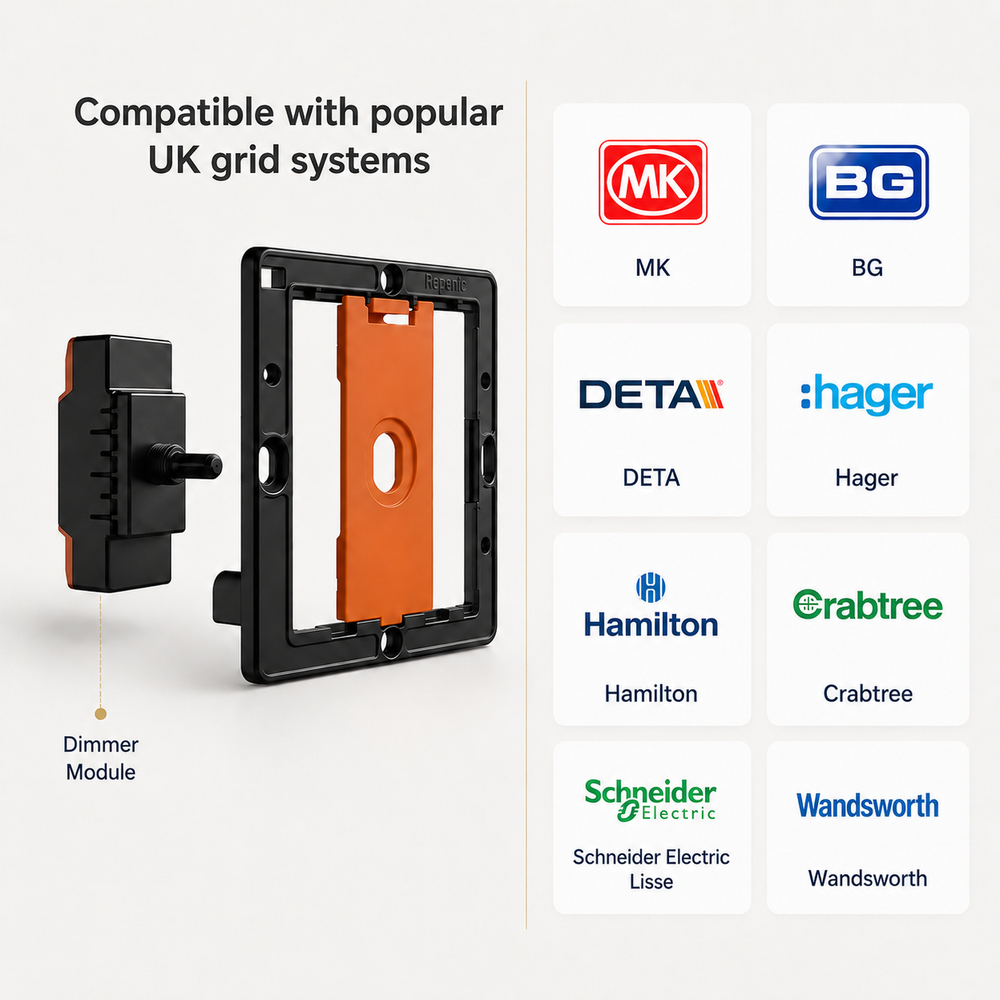
No neutral wire is required at the wall control, making installation easier in many UK properties. The compact mechanism also fits a standard UK 25mm back box.


For compatible 0–10V lighting drivers and control gear.
For compatible motor controllers and variable-speed drives with a 0–10V input.
For compatible pump controllers with a 0–10V control input.
For compatible fan controllers and drives with a 0–10V input
It should be at least 25mm.
A 0-10V dimmer switch is specifically designed for 0-10V or 1-10V lighting control systems, providing smooth dimming from 0% to 100%. It can also be used to control other devices that are controlled by 0-10V signals, such as motors, pumps, and fans.
Only when the lamps are connected through a compatible 0–10V driver. It does not directly control standard mains-dimmable lamps designed for leading- or trailing-edge dimming. For these lamps, please choose our Universal 2-Way Dimmer Switch.
No neutral connection is required at the dimmer. However, the compatible 0–10V driver or controller may still require a neutral connection as part of the wider circuit.
Yes. Dedicated control wiring is required between the dimmer’s D+ and D− terminals and the corresponding control inputs on the compatible 0–10V driver or controller.
No. When connected to a conventional 2-way switch, the second location provides on/off control only. Brightness can be adjusted from the rotary dimmer location.
Yes, it can provide a 0–10V control signal to compatible controllers and drives used with motors, pumps and fans. It does not power these devices directly, and the connected equipment must be compatible with a 0–10V control input and remain within the specified electrical ratings.
Yes, but only if it meets the required safety standards and is placed in the right zone.