
Featured Snippet Yes, dim too-bright LEDs without rewiring UK homes using quick DIY hacks like parchment paper diffusers, softening sheets, or duct tape covers over fixtures. For reliable control, upgrade to Repenic no-neutral dimmers (RD-250/400W LED, trailing/leading edge, BOOST mode) fitting 25mm boxes and MK grids, with dummies for multi-way setups—no electrician needed beyond a simple swap.
Check: How Can You Dim LED Lights Without a Dimmer?
Why Are Your LED Lights Too Bright in a UK Home?
Modern LED bulbs produce intense, concentrated light compared to older incandescent fixtures, often creating harsh glare and uncomfortable ambiance. UK homes with standard wiring rarely have dimmer switches pre-installed, leaving homeowners stuck with full brightness. Renters and listed-property owners face additional barriers to rewiring.
LED technology has transformed UK homes over the past decade, delivering energy efficiency and longevity that traditional bulbs cannot match. However, this efficiency comes with a trade-off: brightness intensity. A single dimmable LED bulb can emit 800–1000 lumens, flooding a living room with light designed for task-focused environments like kitchens or hallways.
The problem intensifies in older UK properties with compact light fittings and reflective surfaces. When LED light bounces off white ceilings and walls, the cumulative glare becomes uncomfortable, particularly during evening hours when softer ambiance is preferred. Many homeowners describe the effect as "feeling like a 747 is about to land in the living room"—an apt metaphor for the jarring intensity.
Standard UK electrical installations rarely include dimmer switches in living spaces, as older properties were designed for incandescent lighting that dimmed naturally at lower power levels. Modern dimmable LEDs require compatible dimming hardware to function properly. Renters and those in listed buildings face additional complexity: rewiring demands electrician approval, landlord consent, or conservation officer clearance—making traditional dimmer installation impractical.
What Are the Quickest DIY Hacks to Reduce LED Glare?
Common quick fixes include parchment paper diffusers placed over light fixtures, softening sheets from craft suppliers, duct tape covers, and heavy curtains or lampshades. These methods reduce glare physically without electrical modification, making them ideal for renters.
For immediate relief without touching electrics, several household items can soften LED brightness:
Parchment Paper Diffusers: Standard kitchen parchment paper, when placed over downlighters or lampshade interiors, scatters light and reduces glare. The paper acts as a simple diffuser, breaking up the concentrated beam into softer, dispersed illumination.
Softening Sheets: Craft suppliers and online retailers offer dedicated LED softening sheets—thin, translucent plastic films designed to diffuse light. These are more durable than parchment and come in various opacity levels for fine-tuned dimming.
Duct Tape Layering: Multiple thin layers of duct tape applied to fixture covers or lampshade frames gradually reduce brightness. Each layer absorbs and reflects some light, allowing customisation by adding or removing layers.
Lampshades and Curtains: Heavy fabric lampshades or blackout curtains physically block direct light, creating softer, ambient illumination. This approach works well for table lamps and pendant fixtures but is less practical for recessed ceiling lights.
These methods are renter-friendly, require no electrical knowledge, and involve minimal cost. However, they carry important limitations and safety considerations for UK homes.
How Does Parchment Paper or Diffuser Sheets Dim LEDs Safely?
Diffuser sheets scatter light by breaking up concentrated LED beams into softer, dispersed illumination. They work by allowing light to pass through a semi-translucent material, reducing glare and perceived brightness without affecting electrical output.
The science behind diffusion is straightforward. LED bulbs produce highly directional light—all photons travel in a narrow cone toward a single point. When this beam hits a diffuser, light scatters in multiple directions, spreading across a wider area. The same total light energy now illuminates a larger space at lower intensity per square metre, which the human eye perceives as dimmer and more comfortable.
Parchment paper works because its fibrous structure contains tiny air gaps that refract light rays. When positioned between the LED source and the room, it breaks the coherent beam into scattered rays, softening shadows and reducing peak brightness. Dedicated softening sheets are engineered for this purpose, with optimised opacity and material composition to maximise diffusion while maintaining adequate light transmission.
Safety Considerations: In UK homes, fire safety is paramount. Parchment paper and most diffusers have flammability ratings, and when placed directly over heat-generating fixtures, they can pose risks. LED bulbs generate far less heat than incandescent bulbs, but extended contact with hot surfaces remains a concern. Always ensure diffusers are not touching the bulb itself and that fixtures have adequate ventilation. For enclosed recessed lights, use only fire-rated diffuser materials or consult the fixture manufacturer's guidance.
Diffusers do not reduce electrical consumption—the LED draws the same power regardless of diffusion. They simply redistribute the light energy, making the same brightness feel softer and less harsh to the eye.
Can Painting or Tape Covers Lower LED Intensity Without Damage?
Yes, duct tape, paint, or opaque covers reduce LED brightness by blocking light physically. However, they risk trapping heat, may damage fixture finishes, and do not solve the underlying need for reliable dimming control—particularly in multi-way setups.
Duct tape and paint-based covers are popular DIY solutions because they are cheap and require no tools. Applying multiple layers of duct tape to lampshade frames or fixture covers gradually reduces light output. Similarly, spray-painting fixture diffusers with semi-opaque paint creates a custom dimming effect.
The limitation is control and reversibility. Once applied, adjusting brightness requires removing and reapplying tape or paint—impractical for daily use. In UK homes with multi-way light switches (common in hallways and landings), tape covers cannot replicate the convenience of dimmer control from multiple locations. Additionally, tape adhesive can damage painted surfaces or fixture finishes, and opaque covers may trap heat in enclosed fixtures, potentially shortening LED lifespan or creating fire hazards in poorly ventilated spaces.
For temporary solutions in rental properties, tape covers work. For permanent installations or homes where you own the property, they represent a poor long-term investment compared to proper dimming solutions.
Why Do DIY Fixes Fail for UK LED Wiring and Multi-Way Setups?
DIY hacks address glare but ignore UK electrical standards, flicker risks, and multi-way switching complexity. UK homes with 25mm back boxes, no-neutral configurations, and MK/BG grid systems require dimming hardware designed for these specifications—not improvised covers.
The UK electrical environment is highly standardised. Most homes built or renovated in the past 20 years feature 25mm-deep back boxes, standard MK or BG grid systems, and wiring that often omits neutral conductors in older circuits. These constraints eliminate many off-the-shelf dimmers sold internationally.
DIY fixes also fail to address flicker—a subtle but real problem with LED technology. Standard LED bulbs are not inherently dimmable; they require specific dimming protocols to function smoothly. Without proper dimming hardware, LEDs can flicker at low brightness levels, creating eye strain and discomfort. In multi-way setups (hallways, landings, stairs), where multiple switches control the same light, DIY covers cannot provide the convenience of dimming from any location.
Fire safety and electrical compliance further complicate DIY approaches. UK homes must meet UKCA standards and Building Regulations. Improvised covers, tape, and paint may not meet fire ratings (V0 classification required for interior electrical installations), creating liability for homeowners and landlords. Renters face particular risk: landlords are responsible for electrical safety, and unapproved modifications could breach tenancy agreements or void insurance.
The most critical failure of DIY fixes is their inability to integrate with modern UK wiring standards. Standard UK electrical circuits operate at 230V AC, 50Hz, with specific load tolerances and safety margins. Proper dimming requires hardware that understands these parameters and automatically adjusts output to prevent flickering, overheating, or damage to LED drivers.
How Do Repenic No-Neutral Dimmers Fit Standard 25mm Back Boxes?
Repenic dimmers are engineered specifically for UK homes, fitting standard 25mm back boxes without requiring a neutral wire—a critical advantage for older properties. Their compact design and trailing/leading edge technology ensure flicker-free dimming of dimmable LEDs up to 250W or 400W.
Repenic's dimmer range addresses a core challenge in UK home electrics: many properties lack neutral wires in light circuits, particularly in older installations. Traditional dimmer switches require both live and neutral connections to function. Repenic's no-neutral design operates using only live and switched-live conductors, making them compatible with nearly all UK wiring configurations.
The Repenic RD-250 Dimmer Switch supports dimmable LED loads up to 250W, with a 400W variant (RD-400) for higher-capacity installations. Both fit standard UK 25mm back boxes and are compatible with leading grid systems including MK, BG, DETA, Hager, Hamilton, Crabtree, Schneider, and Wandsworth. Installation is straightforward: a qualified electrician simply swaps the existing on/off switch for the dimmer, with no rewiring of circuits or addition of neutral conductors required.
The compact form factor is essential for UK homes. Multi-gang installations (2, 3, or 4 gang) automatically de-rate to prevent overload. For example, a 2-gang RD-250 installation supports 212W per dimmer, and a 3-gang setup supports 175W per dimmer. This de-rating ensures safe operation within UK electrical standards.
| Dimmer Model | Load Capacity (Single Gang) | 2-Gang De-Rating | 3-Gang De-Rating | 4-Gang De-Rating | Neutral Required |
|---|---|---|---|---|---|
| RD-250 (LED) | 5–250W | 212W | 175W | 125W | No |
| RD-400 (LED) | 5–400W | 340W | 280W | 200W | No |
Repenic dimmers feature programmable minimum brightness settings (1–50%), allowing users to prevent low-level flicker and ensure LEDs illuminate reliably at any dimming level. The BOOST mode automatically detects LEDs that struggle to ignite at very low brightness and provides a brief power surge to activate them—a common issue with budget LED drivers.
What Makes Trailing Edge Dimmers Ideal for UK Dimmable LEDs?
Trailing edge dimming is the gold standard for LED bulbs, switching off power at the end of each AC cycle to smoothly reduce brightness. It minimises flicker, heat stress on LED drivers, and compatibility issues—making it ideal for UK homes with dimmable LEDs.
UK mains electricity operates on a 50Hz AC cycle, meaning voltage oscillates 50 times per second. Dimming methods must work within this cycle to control brightness without causing visible flicker or damaging LED electronics.
Trailing Edge vs. Leading Edge: Leading edge dimming (older technology) switches power on partway through each AC cycle, creating a sharp voltage spike. This approach works well for incandescent bulbs but stresses modern LED drivers, causing flicker, buzzing, and shortened lifespan. Trailing edge dimming switches power off partway through the cycle, creating a gentler voltage ramp that LED drivers handle smoothly.
Repenic dimmers default to trailing edge mode but offer programmable switching to leading edge for compatibility with specific LED types or legacy installations. The high-speed chipset and tuned MOSFETs (metal-oxide-semiconductor field-effect transistors) ensure switching occurs at precisely the right moment in the AC cycle, delivering flicker-free dimming across the full 0–100% brightness range.
For UK homeowners, this means dimmable LEDs will dim smoothly, silently, and reliably without the buzzing or flickering associated with cheaper dimmers. The technology also protects LED drivers from voltage spikes, extending bulb lifespan and maintaining colour consistency (some poor-quality dimmers cause colour shift at low brightness).
Can Multi-Way Dummy Dimmers Enable 2/3-Way Control Wire-Free?
Yes. Repenic multi-way dummy dimmers (brass or steel, 1–4 gang) function as mechanical 2-way or intermediate switches, allowing dimming control from multiple locations without rewiring circuits. Pair one dimmer with up to two dummies on the same circuit for full multi-way functionality.
UK homes frequently have multi-way light switches—hallways, landings, and staircases controlled from two or three locations. Traditional multi-way wiring requires three separate cables running between switch locations, a significant undertaking in retrofit installations.
Repenic's approach simplifies this. A single Repenic dimmer (RD-250, RD-400, or Zigbee model) is wired in the main switch location. One or two Repenic dummy dimmers are then wired as standard 2-way or intermediate switches at secondary locations. The dummy dimmers are mechanical—they contain no electronics—and simply toggle the dimmer on/off or adjust brightness via the main dimmer's logic. No additional wiring between locations is required beyond standard 2-way switch cabling.
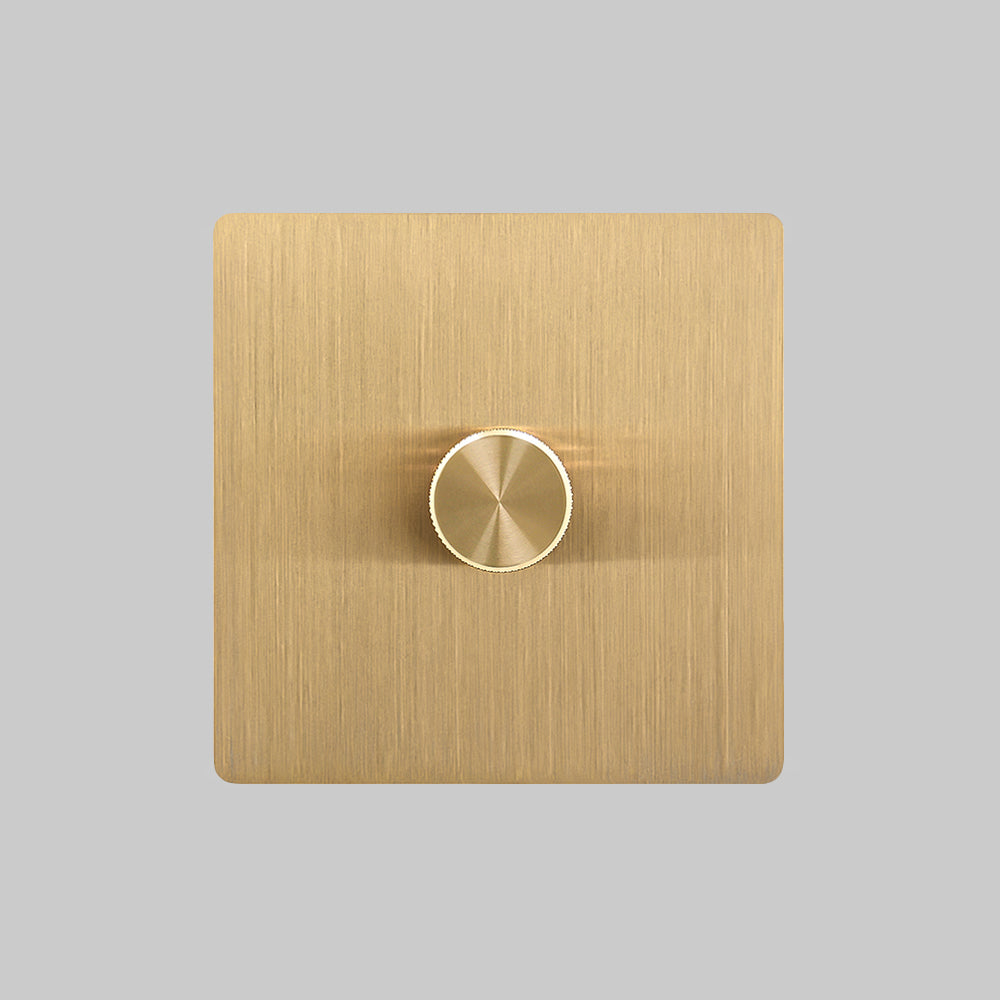
Dummy dimmers are available in solid brass or stainless steel, matching Repenic's premium dimmer finishes. A 1-gang dummy in a hallway, for example, allows users to switch lights on/off or control brightness as if the dimmer itself were at that location. The physical design—featuring an iconic rotary knob—ensures visual consistency across multi-gang installations.
This approach is particularly valuable for renters and listed-property owners. Upgrading a single-location switch to a dimmer plus dummy at a secondary location involves only standard 2-way wiring—the same configuration as any existing multi-way setup. No circuit rewiring, no neutral wire addition, and no major installation disruption.
Which Repenic Smart Zigbee Dimmer Suits Your UK Renovation?
The Repenic Zigbee Smart Dimmer (RD-250ZG) offers app-controlled dimming, energy monitoring, and multi-way control via Zigbee 3.0, ideal for modern renovations. It requires no neutral wire, fits 25mm UK back boxes, and integrates with smart home platforms like Homey and Hubitat.
For homeowners planning a renovation or seeking future-proof lighting control, Repenic's Zigbee Smart Dimmer represents the next evolution. Unlike manual dimmers, the RD-250ZG connects to Zigbee 3.0 networks, enabling remote control via smartphone apps, voice assistants, and automation routines.
Key Features:
The RD-250ZG supports dimmable LED loads up to 250W (5–250W range) and operates without a neutral wire, making it compatible with nearly all UK electrical configurations. It features programmable minimum and maximum brightness, BOOST mode for stubborn LEDs, and soft-start technology to protect bulbs from power surges.
Energy monitoring provides real-time insight into lighting consumption, helping homeowners identify efficiency opportunities. Over-the-air (OTA) updates ensure the dimmer receives firmware improvements without replacement. Advanced modes include moonlight mode (ultra-low ambient lighting), sunrise mode (gradual brightness increase), and co-sleeping mode (reduced standby power consumption).
For multi-way setups, the Zigbee dimmer can work with up to two Repenic multiway dimmers on the same circuit, providing 2-way or 3-way control with full dimming functionality from any location. Unlike dummy dimmers (which are mechanical), multiway dimmers are electronic and communicate with the main Zigbee dimmer via low-voltage signalling, enabling sophisticated control schemes.
Integration with Zigbee 3.0 platforms like Homey and Hubitat opens possibilities for advanced automation: dim lights based on time of day, occupancy sensors, or colour temperature preferences. For UK homeowners investing in smart home infrastructure, the RD-250ZG is a natural choice.
| Dimmer Type | Load Capacity | Neutral Required | Multi-Way Control | Smart Features | Best For |
|---|---|---|---|---|---|
| RD-250 Manual | 5–250W LED | No | With dummy dimmers | None | Budget-conscious, simple dimming |
| RD-400 Manual | 5–400W LED | No | With dummy dimmers | None | High-load installations |
| RD-250ZG Zigbee | 5–250W LED | No | With multiway dimmers | App control, energy monitoring, automation | Modern renovations, smart home integration |
Repenic Expert View: "At Repenic, we've designed our dimmer range specifically for UK homes because we understand the unique constraints: 25mm back boxes, no-neutral circuits, and the need for reliable LED compatibility without rewiring. Our RD-250 and RD-400 manual dimmers solve the immediate problem—flicker-free brightness control in standard installations—while our Zigbee Smart Dimmer future-proofs your home for smart lighting automation. What sets us apart is our commitment to premium materials—solid brass and stainless steel faceplates—combined with engineering that respects UK electrical standards. Whether you're a renter seeking a temporary upgrade or a homeowner planning a full renovation, our multi-way dummy and multiway dimmer options eliminate the need for circuit rewiring. We've helped thousands of UK homeowners transform harsh LED glare into comfortable, controllable ambiance—and we're here to guide you through the compatibility questions that matter."
Conclusion

Too-bright LED lights are a common complaint in modern UK homes, but solutions range from simple DIY hacks to professional-grade dimming hardware. Quick fixes like parchment paper diffusers, softening sheets, and duct tape covers provide immediate relief for renters and those in listed properties, offering glare reduction without electrical modification. However, these approaches lack reliability, fail in multi-way setups, and may pose fire safety risks if not carefully managed.
For permanent, safe, and flexible brightness control, upgrading to a Repenic dimmer switch is the ideal choice. Engineered for UK homes, Repenic's no-neutral dimmers fit standard 25mm back boxes, support dimmable LED loads up to 250W or 400W, and deliver flicker-free trailing-edge dimming across the full brightness range. Programmable minimum brightness and BOOST mode ensure even budget LEDs dim smoothly from any level. Multi-way dummy dimmers enable 2-way or 3-way control without rewiring circuits, making upgrades practical for renters and renovators alike.
For those investing in smart home automation, the Repenic Zigbee Smart Dimmer adds app control, energy monitoring, and integration with platforms like Homey and Hubitat—all without requiring a neutral wire or circuit modification. Whether you choose a manual dimmer or a smart model, Repenic's premium brass and stainless steel finishes ensure your solution matches your home's aesthetic while meeting UK electrical standards and delivering reliable, long-lasting performance.
Frequently Asked Questions
Q: Can I install a Repenic dimmer in a rental property without landlord permission?
A: Technically, you can install a dimmer as a simple switch replacement if your tenancy agreement permits minor modifications. However, best practice is to inform your landlord and ensure the installation complies with Building Regulations. Many landlords appreciate upgrades that enhance comfort and energy efficiency. If you prefer a truly reversible solution, a plug-in dimmer or smart bulbs may be safer alternatives.
Q: Will a Repenic dimmer work with non-dimmable LED bulbs?
A: No. Repenic dimmers are designed for dimmable LED, halogen, and incandescent bulbs. Non-dimmable LEDs contain fixed-output drivers that cannot respond to dimming signals and may flicker or fail if connected to a dimmer. Always verify bulb packaging or product specifications before installation. If your existing bulbs are non-dimmable, replace them with dimmable alternatives—typically only slightly more expensive.
Q: How do I know if my UK home has a neutral wire in the light circuit?
A: A qualified electrician can inspect your wiring to confirm. Older UK homes (pre-1990s) often lack neutral wires in light circuits, relying on live and switched-live conductors only. Repenic dimmers are designed to work with or without a neutral wire, making them compatible with nearly all configurations. If you're unsure, consult a professional before purchasing any electrical equipment.
Q: Can I use parchment paper diffusers on recessed ceiling lights?
A: Parchment paper can work on recessed lights, but ensure adequate ventilation around the fixture to prevent heat buildup. Fire safety is critical—confirm the fixture's manufacturer guidance and use only fire-rated materials if available. For enclosed recessed lights, dedicated LED diffuser kits are safer than improvised solutions. If in doubt, consult a qualified electrician or the fixture manufacturer.
Q: What's the difference between Repenic's manual RD-250 dimmer and the Zigbee RD-250ZG?
A: Both support 5–250W dimmable LED loads and fit standard UK 25mm back boxes without requiring a neutral wire. The manual RD-250 features a rotary knob for local brightness control, programmable minimum brightness, and BOOST mode. The Zigbee RD-250ZG adds app control, energy monitoring, automation routines, and integration with smart home platforms like Homey. Choose the manual version for simplicity and budget; choose the Zigbee version for smart home integration and remote control.