
Featured Snippet Set up Repenic Zigbee 3.0 smart dimmers (5-250W LED, no neutral required) in UK 25mm back boxes for travelers: install via qualified electrician, pair with Zigbee gateway, create randomized sunset/sunrise schedules via Homey or Hubitat for occupancy simulation, and monitor energy remotely to deter burglars while saving power.
Check: How Can You Control Lights Away from Home with Remote?
For UK homeowners who travel frequently, automated lighting is one of the most effective security measures available. Rather than leaving your home dark and obviously unoccupied, smart lighting systems can simulate your presence by turning lights on and off according to realistic patterns—deterring potential burglars while you're away. Unlike basic smart bulbs that require replacing every fixture, professional-grade smart dimmers offer a permanent, whole-home solution that integrates seamlessly with your existing UK electrical infrastructure.
This guide walks you through selecting, installing, and configuring smart lighting specifically for travel security in UK homes, with particular focus on solutions that work in older properties without neutral wires and integrate with cloud-based away-mode routines.
What Makes Smart Dimmers Ideal for Frequent Travelers Over Smart Bulbs?
Smart dimmers control entire light fixtures from a single point, eliminating the need to replace individual bulbs. They offer superior reliability for travelers because they work with any bulb type, provide energy monitoring to verify schedules remotely, support multi-way control across rooms, and integrate permanently into your home's electrical system rather than relying on temporary bulb swaps.
When planning travel security lighting, many homeowners initially consider smart bulbs—products like Philips Hue or LIFX that screw into existing sockets. While convenient for testing, smart bulbs have significant limitations for travelers:
Reliability Issues: Smart bulbs depend on consistent WiFi connectivity and cloud services that may falter during international travel. If your internet connection drops or the bulb's cloud service experiences an outage, your occupancy simulation stops immediately. Smart dimmers using Zigbee 3.0 protocol operate through local mesh networks, continuing to function even if your home WiFi fails.
Fixture Coverage: Smart bulbs only work in fixtures where you've installed them. If you have ten light fittings in your home, you'd need to purchase and install ten smart bulbs. Smart dimmers control entire circuits, meaning a single dimmer switch can manage all lights in your living room, hallway, or bedroom simultaneously—creating coordinated, realistic occupancy patterns across multiple rooms.
Permanent Integration: Smart dimmers become part of your home's electrical infrastructure, installed by qualified electricians during renovation or upgrades. They're not temporary overlays. This permanence matters for travelers who want reliable, maintenance-free security year-round, not solutions requiring bulb replacement or app troubleshooting from abroad.
Energy Monitoring: Repenic's Zigbee smart dimmers include real-time energy tracking, allowing you to verify remotely that your lights are operating on schedule. If a dimmer malfunctions or a schedule fails, you'll see the anomaly in your energy data immediately—critical information when you're thousands of miles away.
Why Choose No-Neutral Zigbee Dimmers for Older UK Homes?
Older UK homes often lack neutral wires in switch circuits, making standard smart dimmers impossible to install. No-neutral Zigbee dimmers like Repenic's models operate on 230VAC without requiring a neutral connection, fitting standard 25mm back boxes and enabling travelers in pre-2000s properties to upgrade to smart lighting without costly rewiring.
UK electrical regulations have evolved significantly. Homes built before the 2000s typically have switch circuits wired with only live and earth conductors—no neutral wire. Modern smart dimmers designed for international markets often require a neutral connection for power, making them incompatible with these older installations.
This creates a genuine problem for UK homeowners: you want smart lighting for travel security, but your home's electrical infrastructure doesn't support standard solutions. Rewiring entire circuits to add neutral conductors is expensive, disruptive, and often unnecessary.
Repenic's Zigbee 3.0 smart dimmers solve this problem directly. Designed specifically for UK homes, they operate without requiring a neutral wire, fitting seamlessly into existing 25mm back boxes. This means you can upgrade to professional smart lighting without electrical rewiring—a significant advantage for travelers in period properties, Victorian terraces, or any home built before modern wiring standards.
The Zigbee 3.0 protocol itself offers additional benefits for travelers. Unlike WiFi-dependent systems that compete for bandwidth and can suffer from range limitations, Zigbee creates a mesh network where each dimmer strengthens the overall signal. Your dimmers communicate locally through this mesh, then connect to a Zigbee gateway (such as Homey or Hubitat) that bridges to cloud services. This architecture means your lights continue operating even if your home WiFi drops—essential for occupancy simulation that must function reliably while you're away.
Which Repenic Smart Dimmer Models Fit UK Grid Systems Best?
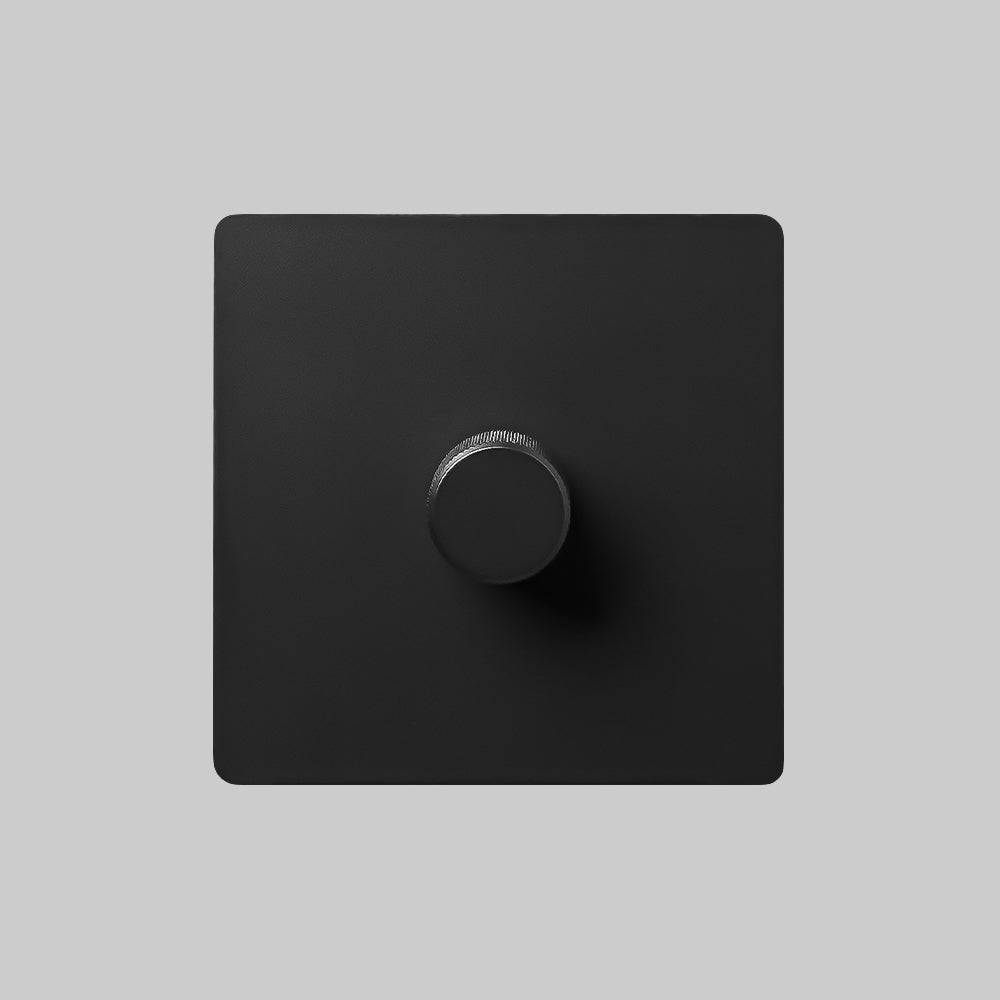
Repenic offers Zigbee 3.0 smart dimmers in black steel, white, and solid brass finishes, all available in 1, 2, 3, and 4-gang configurations. Each model handles 5-250W LED loads, requires no neutral wire, and fits standard UK 25mm back boxes. They're compatible with MK, BG, DETA, Hager, Hamilton, Crabtree, Schneider, and Wandsworth grid systems—covering nearly all UK homes.
Selecting the right smart dimmer model depends on three factors: your home's aesthetic preferences, the number of circuits you're controlling, and your existing grid system.
Finish Options: Repenic's smart dimmers come in three premium finishes. The black steel option suits modern interiors and contemporary renovations. The solid white finish works in minimalist or Scandinavian-inspired homes. The solid brass model delivers a premium, traditional aesthetic ideal for period properties and luxury renovations. All feature 100% solid metal faceplates with knurled knobs—not plastic overlays—ensuring durability and a tactile, quality feel that justifies their role as permanent home infrastructure.
Gang Configurations: Repenic smart dimmers are available in 1, 2, 3, and 4-gang layouts. A single-gang dimmer controls one circuit. Two-gang setups manage two separate circuits from one wall plate. For travelers upgrading entire rooms or creating sophisticated multi-zone lighting patterns, 2-gang and 3-gang configurations reduce the number of wall plates while maximizing control points. Four-gang setups are ideal for hallways, landings, or renovation projects where you're consolidating multiple switches.
Grid Compatibility: The critical consideration for UK homeowners is grid compatibility. Your existing light switches sit in wall boxes manufactured to specific standards by companies like MK, BG, DETA, Hager, Hamilton, Crabtree, Schneider, and Wandsworth. Repenic's smart dimmers are engineered to fit all these systems, meaning you can upgrade without replacing your wall boxes—a major cost and disruption saving during renovation.
| Repenic Smart Dimmer Model | Finish Options | LED Load Capacity | Gang Options | Ideal Use Case |
|---|---|---|---|---|
| Smart Dimmer – Black Steel | Black brushed stainless steel | 5-250W (dimmable LED) | 1, 2, 3, 4 gang | Modern homes, contemporary renovations, minimalist interiors |
| Smart Dimmer – Solid White | White brushed stainless steel | 5-250W (dimmable LED) | 1, 2, 3, 4 gang | Bright, Scandinavian-inspired homes, neutral colour schemes |
| Smart Dimmer – Solid Brass | Solid brushed brass | 5-250W (dimmable LED) | 1, 2, 3, 4 gang | Period properties, luxury renovations, traditional interiors |
All three models operate on 220-240VAC, require no neutral wire, fit standard UK 25mm back boxes, and support the same advanced features: programmable brightness, BOOST mode for stubborn LEDs, soft start technology, and real-time energy monitoring. The choice between them is primarily aesthetic—select the finish that matches your home's interior design and renovation goals.
How Do You Install Repenic Zigbee Dimmers During Renovation?
Installation must be performed by a qualified electrician following UK Building Regulations. The process involves turning off power at the consumer unit, removing existing switches, connecting live and earth wires to the dimmer terminals (no neutral required), securing the dimmer in the 25mm back box, and testing before power restoration. Professional installation ensures safety and compliance.
Smart dimmer installation is not a DIY project in the UK. Building Regulations and electrical safety standards require that all work on fixed electrical installations be completed by qualified electricians registered with a competent person scheme (such as NICEIC, ELECSA, or NAPIT). This protects your home's safety and ensures your installation is compliant and insurable.
When planning your renovation or upgrade, brief your electrician on your travel security goals. Explain that you want Zigbee 3.0 smart dimmers for automated occupancy simulation. Repenic's no-neutral design is particularly valuable for older homes—your electrician will appreciate that they don't need to run new neutral conductors, significantly reducing installation complexity and cost.
Installation Workflow:
Your electrician will follow this process for each dimmer installation:
1. Power Isolation: Turn off the relevant circuit at your consumer unit and verify power is off using a safe isolation tester.
2. Switch Removal: Remove your existing light switch, carefully disconnecting the live and earth wires. (Neutral wires, if present, remain undisturbed in the wall box.)
3. Terminal Connection: Connect the live wire to the appropriate terminal on the Repenic dimmer. Connect the earth wire to the earth terminal. Repenic dimmers accommodate terminal capacity of 1×4mm², 1×2.5mm², 3×1.5mm², or 4×1mm² depending on your wiring gauge.
4. Back Box Installation: Ensure your wall box has a minimum depth of 25mm—standard for most UK installations. Secure the dimmer module into the box, then attach the faceplate (brass, white, or black steel) using the provided screws and knurled knobs.
5. Testing: Restore power and test the dimmer's manual controls. Verify that lights respond smoothly across the full 0-100% dimming range without flickering or buzzing. Repenic's high-speed chipset and tuned MOSFETs ensure silent, flicker-free operation even at low brightness levels.
6. Certification: Your electrician will issue an Electrical Installation Certificate (EIC) or Minor Works Certificate, confirming the installation meets UK standards. This documentation is essential for insurance and future property sales.
Multi-Gang Considerations: If you're installing 2, 3, or 4-gang dimmer setups, your electrician will manage multiple circuits within a single wall plate. Repenic dimmers are designed for this scenario, with each gang controlling a separate circuit independently. This allows you to create sophisticated lighting patterns—for example, your living room lights (one gang) turn on at dusk, your hallway lights (second gang) activate 30 minutes later, and your bedroom lights (third gang) come on an hour before your typical bedtime. These staggered patterns simulate realistic occupancy and are far more convincing to potential intruders than synchronized lighting.
What Automation Schedules Simulate Occupancy While Away?
Create randomized schedules using your Zigbee gateway (Homey or Hubitat) that turn lights on at sunset, off at random times between 10 PM and midnight, and on again before sunrise. Vary schedules daily using the gateway's automation rules to prevent predictable patterns. Include BOOST mode to ensure LEDs illuminate reliably at low brightness, and adjust schedules seasonally as sunset/sunrise times shift.
The most effective occupancy simulation isn't a fixed schedule—it's randomized patterns that change daily. A burglar watching your home will quickly notice if lights turn on at exactly 6:47 PM every evening. Realistic occupancy involves variation: sometimes lights come on earlier, sometimes later; sometimes they stay on until 11 PM, sometimes they're off by 10 PM.
Zigbee Gateway Setup: To create sophisticated automation routines, you'll need a Zigbee 3.0 gateway—a hub device that connects your Repenic dimmers to cloud services and allows remote control from your smartphone. Popular options include Homey and Hubitat, both of which offer enhanced features when used with Repenic's Zigbee dimmers. Your electrician or smart home installer will set up the gateway during or after your dimmer installation, typically placing it in a central location like your hallway or utility room.
Core Occupancy Patterns: Start with these foundational automations:
Evening Activation: Set your living room and hallway dimmers to turn on at sunset (automatically calculated by your gateway based on your location's coordinates). Set brightness to 60-80% for a natural, occupied appearance. This creates the impression that you've come home and switched on evening lights.
Bedroom Activation: Schedule bedroom lights to activate 2-3 hours after sunset at a lower brightness (30-50%), simulating your nighttime routine. Vary this timing by 30-60 minutes daily using your gateway's randomization rules to prevent predictable patterns.
Late Evening Shutdown: Turn off living room lights at a random time between 10 PM and midnight. Use your gateway's randomization feature to vary this timing nightly. Burglars monitoring your home will see inconsistent patterns rather than a fixed schedule.
Morning Activation: Turn on kitchen and bathroom lights 30-60 minutes before sunrise, simulating your morning routine. Again, randomize the exact timing to avoid predictability.
BOOST Mode Optimization: Repenic dimmers include BOOST mode, a feature that ensures dimmable LEDs illuminate reliably even at very low brightness levels. Some LED bulbs struggle to start at 5-10% brightness, appearing to flicker or not illuminating at all. BOOST mode solves this by briefly running the LED at full power before settling to your programmed brightness. Enable BOOST mode in your automation routines to guarantee that low-brightness morning and evening scenes activate flawlessly while you're abroad.
Seasonal Adjustment: Sunset and sunrise times shift throughout the year. In winter, sunset might occur at 3:45 PM; in summer, not until 9:15 PM. Most Zigbee gateways automatically calculate these times based on your location, so your automation routines adapt seasonally without manual intervention. This is a significant advantage over fixed schedules—your occupancy simulation remains realistic year-round.
Randomization Rules: Your Zigbee gateway allows you to create rules like "turn on this dimmer at sunset plus or minus 15 minutes" or "turn off this dimmer at a random time between 10 PM and midnight." Use these features liberally. The more variation in your schedules, the less predictable your home appears and the less attractive it becomes as a burglary target.
How Can Energy Monitoring Verify Lights During Holidays?
Check: Dimmer switch
Repenic Zigbee dimmers include real-time energy monitoring accessible via your smartphone app while traveling. Check your energy consumption daily to verify lights are operating on schedule. Unusual drops in energy usage indicate a dimmer malfunction or schedule failure—allowing you to alert a trusted neighbor or local contact to investigate before returning home.
One of the most overlooked advantages of professional smart dimmers is energy monitoring. While traveling, you can't physically verify that your lights are turning on and off as planned. Energy monitoring solves this by providing remote visibility into your home's lighting activity.
How It Works: Repenic smart dimmers continuously measure the electrical current flowing through each circuit. This data is transmitted to your Zigbee gateway, which sends it to your smartphone app. You can view real-time energy consumption for each dimmer, typically displayed in watts or kilowatt-hours. When you're in Barcelona at 8 AM and your home is 6 hours behind, you can check your app and see exactly what lighting activity occurred during your home's evening and night.
Verification Workflow: Establish a simple daily routine while traveling: each morning (or evening, depending on time zones), check your Repenic dimmer's energy data. You should see clear patterns matching your automation schedules. For example:
- Evening Peak: A spike in energy consumption around sunset, indicating your living room and hallway lights activated on schedule.
- Bedroom Activity: A second, smaller spike 2-3 hours after sunset when bedroom lights turn on.
- Overnight Low: Minimal energy consumption after midnight, confirming lights are off.
- Morning Peak: Another spike before sunrise as kitchen and bathroom lights activate.
If your energy data shows unexpected patterns—no activity during expected lighting times, or consumption spikes at unusual hours—this indicates a problem. Your dimmer may have lost Zigbee connectivity, the automation schedule may have failed, or a bulb may have blown. With this advance warning, you can contact a trusted neighbor, a local property manager, or a friend with a key to investigate and correct the issue before you return home.
This remote verification capability is invaluable for peace of mind. Rather than worrying about whether your occupancy simulation is working, you have objective data confirming your security measures are functioning as intended.
Which Multi-Gang and Dummy Dimmer Setups Create Realistic Patterns?
Combine Repenic smart dimmers with matching dummy dimmers to control lights from multiple locations without smart functionality at every switch. For example, a 2-gang smart dimmer controls your living room lights with automation, while a dummy dimmer in your hallway provides manual control of the same lights. This setup is cost-effective and creates realistic multi-room occupancy patterns for travelers.
Creating convincing occupancy simulation often requires controlling the same lights from multiple locations. Your living room lights might be controlled by a switch in the living room, another switch in the hallway, and potentially a third switch near your front door. Wiring these as traditional 2-way or 3-way switches is straightforward; making them smart while maintaining multi-location control is more complex.
Repenic solves this elegantly with dummy dimmers
Practical Example: Imagine your living room has two light switches—one in the living room itself and one in the hallway. You want to automate the living room lights for travel security, but you also want to maintain manual control from both locations (for when you're home). Here's the optimal setup:
- Location 1 (Living Room): Install a 1-gang Repenic Zigbee smart dimmer. This is your automation hub for this circuit.
- Location 2 (Hallway): Install a matching 1-gang Repenic dummy dimmer in the same finish (brass, white, or black steel) for visual consistency.
- Wiring: Your electrician wires the smart dimmer and dummy dimmer as a traditional 2-way pair, allowing either switch to control the lights. The smart dimmer handles automation routines; the dummy dimmer provides manual override from the hallway.
This configuration gives you the best of both worlds: sophisticated travel automation through the smart dimmer's Zigbee connectivity, plus convenient manual control from multiple locations when you're home. The dummy dimmers are available in 1, 2, 3, and 4-gang configurations and in the same finishes (brass and steel) as the smart dimmers, ensuring visual uniformity across your home.
Multi-Room Coordination: For whole-home occupancy simulation, install smart dimmers in your main living areas (living room, hallway, bedroom) and dummy dimmers at secondary control points. This creates a layered lighting effect: when your living room lights activate at dusk, your hallway lights follow 15 minutes later, and your bedroom lights come on an hour later. These staggered, multi-room patterns are far more convincing than isolated lights in a single room.
| Room/Area | Primary Switch | Secondary Switch | Automation Pattern |
|---|---|---|---|
| Living Room | 1-gang Repenic Smart Dimmer (Brass) | 1-gang Repenic Dummy Dimmer (Brass, hallway location) | On at sunset (70% brightness), off at 11 PM (random ±30 min) |
| Hallway | 2-gang Repenic Smart Dimmer (Brass) | None (hallway has secondary control via living room dummy) | On 15 min after living room, 50% brightness, off at 11:30 PM |
| Bedroom | 1-gang Repenic Smart Dimmer (Brass) | 1-gang Repenic Dummy Dimmer (Brass, landing location) | On 2 hours after sunset (30% brightness), off at 6:30 AM (random ±20 min) |
This coordinated approach creates layered occupancy that evolves throughout the evening and night—far more realistic than synchronized lighting across all rooms.
What UK Regulations Apply to Smart Lighting Installations?
UK smart lighting installations must comply with Building Regulations Part P (electrical safety), BS 7909 (electrical installations), and UKCA safety standards. All work must be completed by a qualified electrician registered with a competent person scheme (NICEIC, ELECSA, or NAPIT). Installation must be certified with an Electrical Installation Certificate or Minor Works Certificate.
Smart lighting isn't exempt from UK electrical regulations—in fact, it's subject to the same rigorous standards as traditional wiring. Understanding these requirements protects your home's safety and ensures your installation is compliant, insurable, and future-proof.
Building Regulations Part P: This regulation governs all electrical work in homes. It requires that installations be designed, installed, and tested by competent persons—typically qualified electricians. The goal is to prevent electrical hazards