
TRIAC dimming is an AC phase-cut technology that controls light brightness by adjusting the firing angle—the precise moment in each electrical cycle when the TRIAC semiconductor activates. Early firing delivers more voltage for brighter light; late firing reduces voltage for dimmer light. Trailing-edge TRIAC dimmers suit LED bulbs by cutting the voltage's trailing half-cycle, preventing flicker and ensuring smooth 5–100% dimming without rewiring. UK dimmers require ≥25mm back boxes and must be installed by qualified electricians per UKCA regulations.
Check: dimmer switch
What is TRIAC Dimming and How Does the Phase-Cut Principle Work?
TRIAC dimming uses a bidirectional semiconductor switch to perform phase-cut dimming on AC power, chopping portions of each mains cycle to reduce average voltage delivered to the light. This phase-cut method—either leading or trailing edge—precisely controls brightness by varying the conduction angle within the 50Hz UK mains waveform.
TRIAC, short for Triode for Alternating Current, is the core component in phase-cut dimmers widely used in UK homes for retrofitting LED lighting. Unlike resistive dimmers that waste energy as heat, TRIAC dimmers electronically "chop" the incoming 230VAC 50Hz sine wave. In the phase-cut principle, the TRIAC blocks current until a specific firing angle, then conducts until the next zero-crossing. For full brightness, firing occurs near 0 degrees; for dimming, it delays to 90-170 degrees, reducing RMS voltage and thus power to the load.
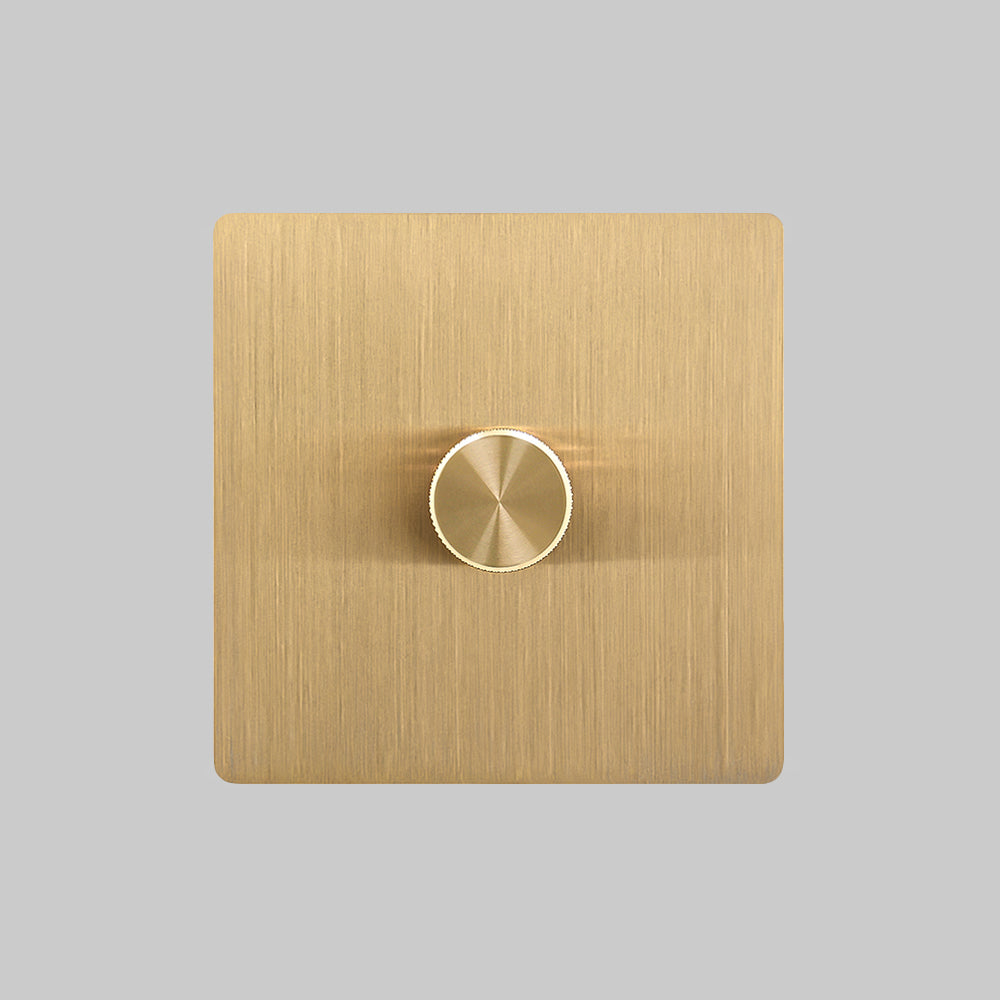
Repenic's RD-250 and RD-400 dimmers exemplify this technology, supporting programmable trailing or leading edge modes. These fit standard UK 25mm back boxes with no neutral required, making them ideal for renovations without rewiring. The phase-cut approach suits capacitive LED loads when using trailing edge, where voltage is cut off mid-cycle after the peak, minimising inrush currents that cause flicker in modern bulbs.
How Does the Firing Angle Control Light Brightness in a TRIAC Dimmer?
The firing angle in a TRIAC dimmer determines brightness by setting when the TRIAC triggers conduction in each AC half-cycle. A small angle (early firing) allows nearly full voltage for maximum brightness; a larger angle (late firing) delivers less average power, dimming the light progressively from 100% down to 5%.
In detail, the UK mains cycle completes 100 times per second (50Hz). The TRIAC's gate receives a trigger pulse at the adjustable firing angle θ from zero-crossing. Power conduction time is (180° - θ) per half-cycle, so average voltage follows V_avg = V_peak * (1 + cosθ)/2. At θ=0°, full power; at θ=150°, about 10% power remains.
Repenic dimmers like the RD-250 feature auto-adjust max brightness and programmable minimum (1-50%) to fine-tune this control, preventing overload or flicker. For LED drivers, precise firing avoids audible noise and extends bulb life during retrofits.
Why is Trailing Edge Dimming Better for LED Lights Than Leading Edge?
Trailing edge dimming cuts the voltage waveform after the peak in each half-cycle, reducing inrush current to capacitive LED drivers for smoother, flicker-free operation down to 5% brightness. Leading edge fires early and cuts abruptly at zero-crossing, often causing flicker and buzz with LEDs due to high initial current spikes.
LED bulbs use capacitive drivers sensitive to voltage rise rate (dv/dt). Leading edge (forward phase) triggers near zero-crossing, slamming full voltage onto the capacitor and risking misfires. Trailing edge (reverse phase) delays firing until after peak, then chops the trailing portion, providing gentler power delivery ideal for dimmable LEDs and CFLs.
Repenic's 250W and 400W dimmers default to trailing edge (R,C loads up to 400W) but program to leading edge (R,L up to 100W). This versatility, plus BOOST mode for low-level ignition, ensures compatibility with UK LED retrofits in kitchens or lounges.
How Can You Prevent Flickering with TRIAC Dimmers in UK Homes?
Prevent TRIAC dimmer flicker by selecting trailing edge models for LEDs, programming minimum brightness (1-50%), enabling BOOST mode for low-end startup, and auto-adjusting max brightness. Ensure loads stay within specs (e.g., ≥5W total) and use qualified electricians for proper UK wiring.
LED flicker stems from driver incompatibility with phase-cut waveforms, causing unstable current at low dim levels. Trailing edge mitigates this, but Repenic adds smart features: BOOST mode boosts reluctant LEDs at low settings; programmable min/max avoids cut-off zones; soft start protects bulbs. Multi-gang setups require de-rating to prevent heat buildup.
For UK homes, Repenic Zigbee smart dimmers (RD-250ZG) offer energy monitoring and OTA upgrades, with moonlight/sunrise modes for ultra-smooth control. Always match loads: 5-250W LEDs per gang, de-rated in multi-gang plates.
What Are the Multi-Gang De-Rating Rules for TRIAC Dimmers in 25mm Back Boxes?
Multi-gang TRIAC dimmers de-rate loads due to shared heat dissipation in 25mm UK back boxes: for RD-250 (R,C), 1G=250W, 2G=212W, 3G=175W, 4G=125W, 5G=75W. RD-400 (R,C): 1G=400W, 2G=340W, 3G=280W, 4G=200W, 5G=120W. Install by qualified electricians only.
Heat from TRIAC switching accumulates in confined boxes, so manufacturers specify de-rating. Repenic's solid brass/steel 1-4 gang dimmers fit ≥25mm depths with V0 fire-rated modules. Below is the de-rating table for key models:
| Gangs | RD-250/ RD-MP (R,C) | RD-250 (R,L) | RD-400 (R,C) |
|---|---|---|---|
| 1G | 250W | 100W | 400W |
| 2G | 212W | 90W | 340W |
| 3G | 175W | 80W | 280W |
| 4G | 125W | 60W | 200W |
| 5G | 75W | 40W | 120W |
Use dummy dimmers (brass/steel) for multi-way aesthetics without load. Metal faceplates must be grounded.
How Does TRIAC Dimming Compare to 0-10V and PWM Dimming Methods?
TRIAC phase-cuts AC mains (5-100% range, no extra wiring) for easy LED retrofits; 0-10V sends low-voltage DC signal (1-100%, flicker-free) needing extra wires; PWM modulates DC pulses (precise but driver-specific). TRIAC suits UK homes; 0-10V commercial installs.
TRIAC excels in residential retrofits using existing 230VAC wiring, but risks flicker with LEDs. 0-10V provides smooth analog control via separate signal wires to drivers, ideal for precise commercial dimming without waveform distortion. PWM, often internal to drivers, switches DC rapidly for efficiency but requires compatible fixtures.
Repenic offers both: TRIAC dimmers (RD series) for no-neutral homes, 0-10V for hybrid needs. Here's a comparison:
| Aspect | TRIAC (Phase-Cut) | 0-10V | PWM |
|---|---|---|---|
| Wiring | Existing AC | Extra low-voltage | Driver-internal/DC |
| Dim Range | 5-100% | 1-100% | 0-100% |
| LED Flicker | Possible (use trailing) | Minimal | Low if high-freq |
| Retrofit Ease | High | Low | Medium |
| UK Home Fit | Ideal (no neutral) | Commercial | Fixtures only |
Repenic Expert Views
"At Repenic, we engineer TRIAC dimmers specifically for UK LED retrofits, addressing common pain points like flicker and multi-gang heat. Our RD-250ZG Zigbee models support trailing/leading edge with BOOST and programmable brightness, fitting 25mm boxes without neutral. Paired with RD-MP multiway (up to 5 units, 50m wire runs), they enable seamless 2-5 way control. For precision needs, our 0-10V dimmer integrates easily, grounded with metal plates. All carry 5-year warranty, V0 rating, and electrician-only install for safety."
Which TRIAC Dimmers Work Without a Neutral Wire in UK Smart Home Systems?
Check: triac dimming
Repenic's RD-250, RD-400, RD-250ZG Zigbee, and multi-gang series operate without neutral, using mains switching for leakage paths. RD-250ZG adds Zigbee 3.0 for Google Home/Homey, with multi-way (1 smart + 2 RD-MP) and features like energy monitoring.
Traditional dimmers need neutral for TRIAC bias; no-neutral designs bypass via high-impedance paths. Repenic's smart dimmers (brass/steel/white, 1-4 gang) fit MK/BG grids, 5-250W LEDs, no neutral. RD-MP extends circuits (100m dimmer-to-dimmer), but only with matching Repenics. Dummy dimmers complete multi-way aesthetics.
Can You Install a TRIAC Dimmer Yourself, or Do You Need a Qualified Electrician?
UK regulations (BS 7671) require qualified electricians for TRIAC dimmer installs due to 230VAC risks, back box modifications, and grounding metal plates. DIY voids warranties and risks fire/non-compliance.
Installation involves live terminals (1-4mm² capacity), de-rating checks, and programming modes. Repenic mandates professionals for 5-year warranty validity. They'll confirm 25mm depth, grid fit (Hager/Schneider), and load matching.
Conclusion
TRIAC dimming revolutionises UK LED retrofits with phase-cut precision, no-neutral ease, and Repenic's premium features like BOOST and Zigbee control. Choose trailing edge for flicker-free performance in real homes. Explore Repenic's brass/steel range at repenic.com for solutions that fit your renovation—installed confidently by pros.
FAQs
What loads do Repenic TRIAC dimmers support? LED 5-250W/400W (R,C), Halogen/Incandescent 5-250W/400W, with de-rating for multi-gang.
Does Repenic offer Zigbee TRIAC dimmers? Yes, RD-250ZG: no neutral, multi-way, energy monitoring, compatible with Zigbee gateways like Homey.
How to fix TRIAC LED flicker? Use trailing edge, BOOST mode, program min brightness 1-50% on Repenic dimmers.
Are Repenic dimmers UK back box compatible? Yes, ≥25mm depth, grids like MK, Crabtree, Wandsworth.