
No, you don't need a dimmer bypass with Repenic dimmers—they handle 5–250W LEDs flicker-free from 1% brightness using BOOST mode, programmable min/max levels, and trailing/leading edge technology, fitting UK 25mm boxes without neutral. Unlike many competing smart dimmers that require separate bypass accessories, Repenic's advanced chipset and tuned MOSFETs eliminate the need for extra hardware on low-load circuits. This guide explains when bypasses are genuinely needed for other systems, why Repenic dimmers solve the problem built-in, and how to troubleshoot LED dimming issues in your UK home renovation.
Check: How to Dim LED Lights Without a Dimmer: 5 Simple UK Hacks?
What Is a Dimmer Bypass and Why Do LEDs Need It?
A dimmer bypass is a small capacitive device that draws a minimal current through a dimmer circuit to keep it powered when LED loads fall below the dimmer's minimum holding current. Traditional incandescent bulbs draw enough current to maintain a dimmer's triac (a semiconductor switch), but modern LEDs consume far less power—often just 5–10 watts for a whole room. When LED current drops below the triac's holding threshold, the dimmer loses its electrical "grip" on the circuit, causing flickering, inconsistent dimming, or lights that won't turn on at all.
The problem is most acute in no-neutral wiring configurations common in older UK homes. Without a neutral wire to complete the circuit, the dimmer relies entirely on current flowing through the light to maintain operation. When that current is too low—as with ultra-efficient LEDs—the circuit becomes unstable. A bypass module, typically just an encapsulated capacitor, adds just enough dummy load to keep the dimmer functioning smoothly across the full dimming range.
This technical challenge has driven the market for bypass accessories from brands like Aeotec, Zooz, and Legrand. However, modern dimmer design—particularly trailing and leading edge technology—has made bypasses optional or unnecessary in many UK installations, especially with dimmers engineered specifically for low-wattage LED loads.
When Do You Need a Dimmer Bypass for Low-Wattage Lights?
You need a dimmer bypass if your dimmer's minimum load specification is higher than your total LED wattage, your installation has no neutral wire, and your dimmer uses older triac-based technology without programmable minimum brightness settings. For example, if you're dimming four 3-watt LED bulbs (12W total) with a dimmer rated for a 40W minimum load, a bypass becomes essential to prevent flickering or failure to illuminate at low levels.
Bypass necessity depends on three factors:
1. Total Load vs. Minimum Specification: Check your dimmer's datasheet. If your combined LED wattage falls below the stated minimum (often 40–60W for older dimmers), a bypass is likely needed. UK electricians frequently encounter this in renovations where homeowners retrofit compact LED downlighters into vintage lighting circuits designed for halogen or incandescent loads.
2. Wiring Configuration: No-neutral installations are far more common in UK homes built before the 2000s. If your light switch box has only a live and switched-live wire—no neutral return—your dimmer must draw its operating power from the load circuit itself. This makes bypasses more critical than in neutral-wired systems, where the dimmer can draw standby current independently.
3. Dimmer Technology: Older triac-based dimmers lack the intelligent load-sensing features of modern designs. Contemporary dimmers use high-speed chipsets and programmable brightness thresholds to adapt to ultra-low loads. If your dimmer is a basic rotary or slider model without digital controls, a bypass is more likely to be necessary.
Common scenarios requiring bypasses include:
- Dimming 4–6 small LED spotlights in a kitchen or bathroom (total load under 20W)
- Smart dimmers like Shelly or older Z-Wave modules in no-neutral circuits with LEDs under 30W
- Retrofitting LED bulbs into existing halogen dimmer circuits without upgrading the dimmer itself
- Multi-gang setups where total load is de-rated (e.g., a 2-gang dimmer rated for 250W per gang drops to 212W, but you're only using 15W of LEDs)
Does a No-Neutral Dimmer Always Require a Bypass?
No. Modern no-neutral dimmers with programmable minimum brightness, BOOST mode, and optimised triac designs can handle ultra-low LED loads (5W and above) without a bypass, provided total load meets the dimmer's minimum specification. The key differentiator is dimmer engineering, not wiring configuration alone.
The misconception that all no-neutral dimmers need bypasses stems from older technology. Classic triac dimmers in no-neutral circuits do require a bypass because they cannot regulate their own holding current—they depend entirely on load current to stay "latched" during each half-cycle of the AC mains. However, contemporary dimmers solve this through intelligent circuit design.
Repenic's no-neutral dimmers, for instance, incorporate a high-speed chipset and tuned MOSFETs that stabilise the circuit even at very low wattages. The RD-250 and RD-400 models are rated for LED loads as low as 5W in resistive/capacitive configurations, eliminating the need for a bypass in most UK domestic installations. These dimmers also feature programmable minimum brightness settings (adjustable from 1–50%), allowing you to fine-tune the lowest illumination level at which the circuit remains stable.
The critical factor is whether your dimmer's design includes:
- Programmable or adaptive minimum brightness thresholds
- BOOST mode or soft-start functionality for low-level illumination
- High-frequency switching (typically 20kHz or higher) to smooth current delivery
- Compatibility with ultra-low wattage loads (5W minimum)
If your existing no-neutral dimmer lacks these features, a bypass is a practical solution. If you're upgrading, choosing a modern dimmer engineered for low-wattage LEDs eliminates the bypass requirement entirely.
Why Do Smart Dimmers Like Shelly Need a Bypass in UK Homes?
Shelly and similar Wi-Fi smart dimmers often require bypasses in UK no-neutral installations because their triac-based switching relies on minimum load current to maintain operation, and many models lack programmable minimum brightness or BOOST mode to compensate for ultra-low LED wattages.
Smart dimmers are popular for their app control and integration with platforms like Google Home, but not all are optimised for the low-wattage LED loads prevalent in modern UK homes. Shelly dimmers, whilst feature-rich, use conventional triac technology that demands a baseline current flow. In a no-neutral circuit with, say, 8W of LEDs, the triac's holding current requirement may exceed the available load current, causing the dimmer to lose synchronisation and flicker.
Additionally, many Wi-Fi smart dimmers prioritise connectivity over load optimisation. They're designed to work across global markets with varying electrical standards, so they often don't include the granular brightness control or boost functionality needed for UK-specific low-wattage scenarios. A bypass becomes a practical workaround to ensure reliable operation without replacing the dimmer.
This is where Repenic's approach differs. Repenic's Zigbee Smart Dimmer (RD-250ZG) and manual dimmer switches are engineered specifically for UK homes, with features like BOOST mode, programmable minimum brightness (1–50%), and a 5W minimum LED load specification. These dimmers work without neutral and without a bypass, offering smart control via Zigbee 3.0 (compatible with Homey, Hubitat, and other open platforms) without the compromise of requiring additional hardware.
Can Repenic Dimmers Work Without a Dimmer Bypass?
Check: How Can You Fix LED Dimmer Switch Flickering in UK Homes?
Yes. Repenic dimmers are designed to work without a bypass in the vast majority of UK domestic installations. All Repenic dimmer models—including the RD-250, RD-400, RD-250ZG (smart), and RD-MP (multiway)—are rated for LED loads as low as 5W in resistive/capacitive configurations, eliminating the need for separate bypass accessories.
| Repenic Dimmer Model | Minimum LED Load | Programmable Min Brightness | BOOST Mode | No-Neutral Compatible | Bypass Required |
|---|---|---|---|---|---|
| RD-250 (Manual) | 5W (R,C) | 1–50% | Yes | Yes | No |
| RD-400 (Manual) | 5W (R,C) | 1–50% | Yes | Yes | No |
| RD-250ZG (Smart/Zigbee) | 5W (R,C) | Programmable | Yes | Yes | No |
| RD-MP (Multiway) | 5W (R,C) | Programmable | Yes | Yes | No |
This is a significant advantage for UK renovators. Instead of purchasing a dimmer, testing it, and then buying a bypass accessory if flickering occurs, Repenic dimmers arrive "flicker-free ready." The RD-250 and RD-400 manual dimmers fit standard UK 25mm back boxes and support both trailing edge (default) and leading edge dimming modes, adapting to different LED driver types. The RD-250ZG adds Zigbee smart control without requiring a neutral wire—a feature rarely found in competing brands.
For multi-gang installations common in UK kitchens and open-plan living spaces, Repenic's RD-MP multiway dimmer allows up to five units on the same circuit, with a combined load requirement of just 15W minimum. This means you can dim multiple zones of LED downlighters without bypass hardware, provided total load exceeds 15W.
The absence of bypass requirements also simplifies installation for electricians. Fewer components mean faster setup, fewer potential failure points, and cleaner wiring in the back box—important in confined UK electrical enclosures where space is at a premium.
How Does BOOST Mode Eliminate the Need for a Bypass?
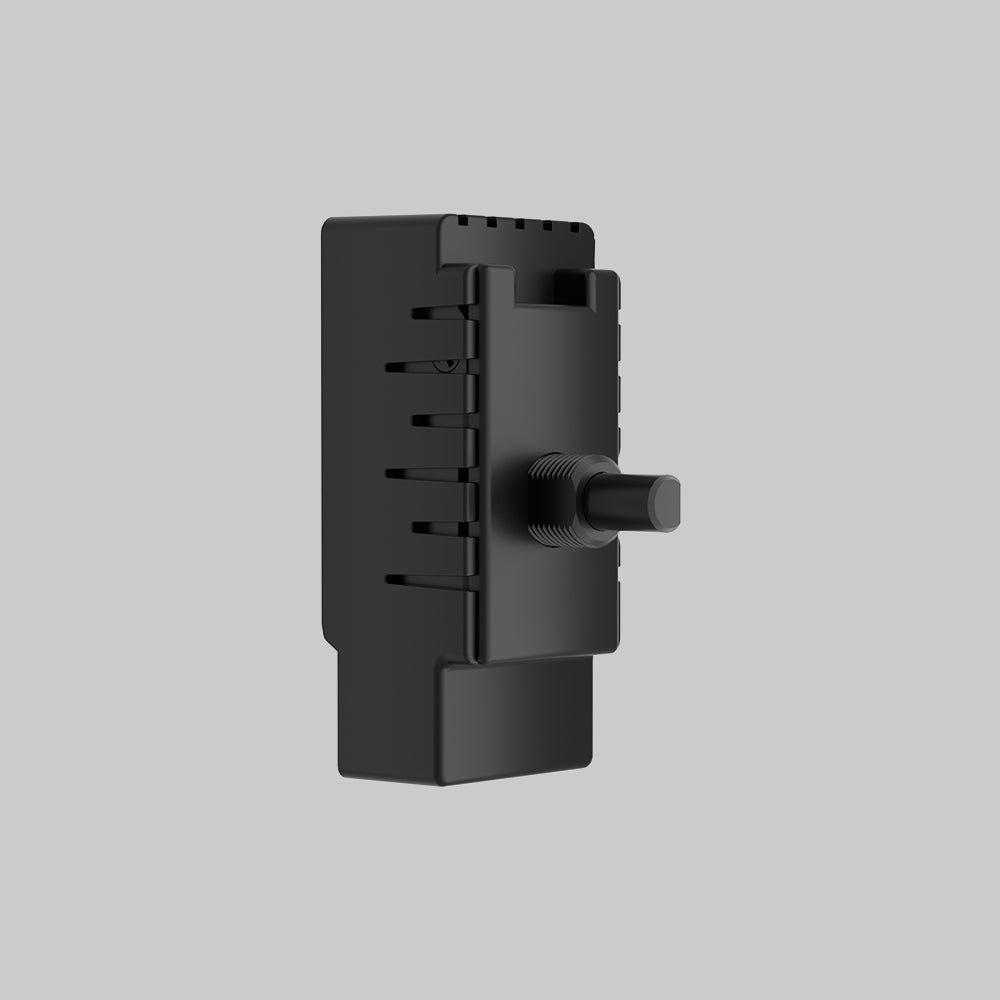
BOOST mode is a firmware-driven feature that temporarily increases voltage or current at low brightness levels to ensure LEDs illuminate reliably even when total load falls below the dimmer's normal minimum threshold, effectively replacing the passive bypass function with active circuit management.
Traditional bypasses work passively—they simply add a fixed capacitive load to the circuit. BOOST mode, by contrast, is an intelligent feature built into Repenic's high-speed chipset. When you set a dimmer to a very low brightness level (say, 5% for ambient lighting), the dimmer's firmware detects that LED current is dropping and automatically compensates by slightly boosting the voltage or adjusting switching frequency. This keeps the triac latched and prevents the flickering or dropout that would occur without intervention.
The advantage is twofold:
1. Adaptive Performance: BOOST mode activates only when needed, so it doesn't waste energy or add unnecessary load at full brightness. A bypass, by contrast, continuously draws a small current regardless of dimming level.
2. Programmable Control: Repenic dimmers allow you to set minimum brightness from 1–50%, so you can dial in the exact lowest level at which your specific LEDs reliably illuminate. This fine-tuning, combined with BOOST mode, handles ultra-low wattage scenarios that would require a bypass on older dimmers.
For example, imagine a bathroom with six 2W LED spotlights (12W total) on a no-neutral dimmer. Without BOOST mode, you might only be able to dim to 20% brightness before flickering occurs. With Repenic's BOOST mode and programmable minimum brightness, you can set the dimmer to smoothly dim all the way to 1%, with the firmware automatically stabilising the circuit at lower levels. The result is flicker-free dimming across the full range—no bypass needed.
This is particularly valuable in UK homes where energy efficiency is increasingly mandated by Building Regulations Part L. As LED wattages drop and multi-room dimming becomes standard, BOOST mode and programmable brightness thresholds are essential features for hassle-free installations.
What Are the Risks of Installing a Dimmer Bypass Incorrectly?
Incorrect bypass installation risks electrical short circuits, fire hazard (especially if bypass components are not rated for mains voltage), damage to the dimmer or LEDs, and voiding warranties. Bypasses must be installed by a qualified electrician following the dimmer manufacturer's wiring diagram, with all connections properly isolated and secured within the back box.
Common installation mistakes include:
- Wrong Bypass Component: Using a bypass rated for low-voltage circuits (e.g., 12V) on a 230V mains circuit will fail catastrophically, potentially causing fire or electrocution.
- Improper Wiring: Connecting the bypass to the wrong terminals (e.g., live-to-live instead of live-to-load) creates a short circuit and trips the circuit breaker or causes permanent damage to the dimmer.
- Overcrowded Back Box: UK back boxes are typically shallow (25mm minimum depth). Cramming a dimmer, bypass, and wiring into a confined space can damage insulation, create arcing, or prevent the faceplate from seating properly.
- Inadequate Isolation: If bare wires or terminal screws are not fully covered with electrical tape, touching the back box can cause electric shock or short circuits during maintenance.
- Incompatible Dimmer/Bypass Pairing: Not all bypasses work with all dimmers. Mixing incompatible brands can result in the bypass drawing too much or too little current, negating its benefit or causing damage.
UK Building Regulations and the 18th Edition Wiring Regulations (BS 7909) require all electrical work to be carried out by a qualified electrician and certified upon completion. Installing a bypass incorrectly can invalidate your home insurance and create a safety liability if a fault occurs later.
This is another reason Repenic dimmers are attractive: by eliminating the bypass requirement, you reduce installation complexity, the risk of wiring errors, and the need for specialist troubleshooting. A qualified electrician can install a Repenic dimmer following standard wiring practices without needing to source, test, or wire a separate bypass component.
Which Repenic Dimmer Is Best for Multi-Way UK Setups?
For multi-way setups in UK homes, Repenic's RD-MP (Multiway Dimmer) is the ideal choice, supporting up to five units on the same circuit with a 15W minimum combined load and seamless 2-way or 3-way control without bypass hardware. Alternatively, the RD-250ZG Zigbee Smart Dimmer can be paired with Repenic dummy dimmers for flexible smart control.
Multi-way dimming is common in UK homes—think of a hallway with switches at both ends, or a kitchen with dimmers controlling the same lights from multiple locations. Traditionally, this required either expensive smart home systems or complex wiring with intermediate switches. Repenic simplifies this with two approaches:
1. RD-MP Multiway Dimmer: This is a manual dimmer designed specifically for multi-location control. You can wire up to five RD-MP units on the same circuit, each controlling the same lights independently. Total load must be at least 15W, but individual dimmers can have loads as low as 5W. All units fit standard UK 25mm back boxes and work without neutral. No bypass is required because each dimmer is engineered with the same low-wattage capability as the RD-250.
2. RD-250ZG Smart Dimmer + Dummy Dimmers: The RD-250ZG is Repenic's Zigbee 3.0 smart dimmer, compatible with platforms like Homey and Hubitat (and integrable with Google Home via a compatible hub). You can pair one RD-250ZG with up to two Repenic dummy dimmers on the same circuit. The dummy dimmers are manual 2-way or intermediate switches that match the aesthetic of the smart dimmer but don't require power or configuration. When you adjust brightness on the smart dimmer or via app, all connected dummy switches update in sync. This setup also requires no bypass.
| Multi-Way Setup Type | Repenic Product | Max Units on Circuit | Minimum Combined Load | Smart Control | Back Box Depth |
|---|---|---|---|---|---|
| Manual Multi-Way | RD-MP (up to 5 units) | 5 | 15W | No | ≥25mm |
| Smart Multi-Way | RD-250ZG + 2 Dummy Dimmers | 3 (1 smart + 2 dummy) | 15W | Yes (Zigbee 3.0) | ≥25mm |
| Single-Location Manual | RD-250 or RD-400 | 1 | 5W | No | ≥25mm |
| Single-Location Smart | RD-250ZG | 1 | 5W | Yes (Zigbee 3.0) | ≥25mm |
For most UK renovations, the RD-MP multiway dimmer is the simplest solution. It's affordable, requires no hub or app, and all five units can be identical in appearance (available in brass, steel, or white finishes). If you want smart control and integration with Google Home via a Zigbee hub, the RD-250ZG + dummy dimmers combination is ideal, offering flexibility without sacrificing the bypass-free, low-wattage performance that Repenic dimmers provide.
Repenic Expert Views: "At Repenic, we've engineered our dimmers to solve the UK home renovation challenge head-on. Most homeowners upgrading to LEDs expect to buy a dimmer and have it work—but many discover bypasses are needed, adding cost and complexity. Our RD-250, RD-400, and RD-250ZG dimmers are designed with a 5W minimum LED load and BOOST mode built-in, so you get flicker-free dimming from day one. Whether you're retrofitting a Victorian terraced house without neutral wires or installing smart multi-way control in a modern open-plan kitchen, Repenic dimmers fit UK 25mm back boxes and handle the job without extra hardware. That's the Repenic difference—premium performance without the hassle."
Conclusion
Dimmer bypasses are a practical solution for older dimmer technology or specific low-wattage scenarios, but they're no longer necessary for modern UK home installations if you choose the right dimmer. The key is selecting a dimmer engineered for ultra-low LED loads with features like BOOST mode, programmable minimum brightness, and no-neutral capability.
Repenic dimmers eliminate the bypass requirement entirely, offering flicker-free dimming from 5W and above, fitting standard UK 25mm back boxes, and supporting everything from simple manual dimmers to smart Zigbee-enabled systems. Whether you're upgrading a single room or managing a full home renovation, Repenic provides the reliability, UK-specific compatibility, and premium finishes you need—without the added expense and complexity of bypass accessories.
For a hassle-free LED dimming experience in your UK home, explore Repenic's range of dimmer switches and discover why thousands of homeowners and trade professionals trust them for energy-efficient, flicker-free lighting control.
Frequently Asked Questions
Do I need a dimmer bypass for all LED lights?
No. Bypasses are only needed if your total LED load falls below your dimmer's minimum specification, your installation has no neutral wire, and your dimmer lacks advanced features like BOOST mode or programmable minimum brightness. Modern dimmers engineered for low-wattage loads—such as Repenic's RD-250 and RD-400—handle 5W and above without a bypass.
Can I install a dimmer bypass myself?
No. UK Building Regulations require all electrical work, including dimmer and bypass installation, to be carried out by a qualified electrician. Incorrect installation risks electrical shock, fire, damage to appliances, and voiding your home insurance. Always consult a certified electrician.
What's the difference between trailing edge and leading edge dimming?
Trailing edge dimming (default on Repenic dimmers) is gentler on LED drivers and works with most modern LED bulbs. Leading edge dimming is older technology but compatible with certain LED types. Repenic dimmers support both modes, allowing you to choose the best option for your specific bulbs and avoid flickering.
Can I use a Repenic dimmer in a no-neutral UK home?
Yes. All Repenic dimmer models—RD-250, RD-400, RD-250ZG, and RD-MP—are designed to work without a neutral wire, which is common in older UK homes. No bypass is required.
How do I know if my dimmer needs a bypass?
If your LED lights flicker at low brightness levels, won't turn on at all, or remain dimly lit when switched off, your dimmer may need a bypass. However, before buying a bypass, check your dimmer's minimum load specification and total LED wattage. If they're incompatible and your dimmer lacks BOOST mode or programmable brightness, a bypass is likely the solution. Alternatively, upgrading to a modern dimmer like Repenic's eliminates the problem permanently.