
A potentiometer dimmer switch uses a three-terminal variable resistor with a rotary wiper to act as a voltage divider, adjusting output voltage for smooth 0–100% dimming of LEDs, halogens, and incandescents. In UK homes, Repenic models support trailing/leading edge modes, no-neutral wiring, and multi-way circuits, fitting ≥25mm back boxes with flicker-free MOSFET control and BOOST mode for low-level lights.
Check: pottentiometer
What Is a Potentiometer and How Does It Function as a Variable Resistor?
A potentiometer is a three-terminal resistive device with a movable wiper contact that divides electrical resistance. As you rotate the knob, the wiper slides along a resistive element, changing the proportion of resistance in the circuit—from minimum (full brightness) to maximum (off or dim). This variable resistance is the foundation of rotary dimmer control.
At its core, a potentiometer is an analog control component designed to vary electrical resistance smoothly across a range. Unlike a standard on/off switch that has only two states, a potentiometer offers infinite positions between full resistance and zero resistance. The device consists of three terminals: two end terminals connected to the resistive element, and a wiper terminal that slides along this element as you turn the knob.
When you rotate a dimmer's rotary knob, you're physically moving the wiper contact. This changes how much of the resistive element is in the circuit. At the minimum resistance position, current flows freely—lights are bright. At maximum resistance, current is heavily restricted—lights dim or turn off. This gradual, continuous adjustment is what gives potentiometer-based dimmers their smooth, flicker-free performance.
In modern dimmer switches, the potentiometer is paired with electronic control circuits (like high-speed chipsets and MOSFETs) that translate the wiper position into precise voltage control. This combination allows dimmer switches to deliver consistent performance across different light types—incandescent, halogen, and dimmable LED—without the buzzing or flickering that plagued older mechanical dimmers.
How Does a Potentiometer Work as a Voltage Divider in Dimmer Switches?
A potentiometer acts as a voltage divider by splitting the input voltage (230V AC in UK homes) proportionally based on wiper position. The output voltage sent to the light fixture varies from near-zero volts (dim) to full supply voltage (bright), allowing precise brightness control. Electronic circuits then modulate this to create flicker-free dimming.
The voltage divider principle is central to how potentiometer dimmers achieve smooth brightness adjustment. Imagine the potentiometer as a resistive track with a wiper that can slide anywhere along its length. The input voltage (230V AC from your UK wall circuit) is applied across the two end terminals of this track. The wiper taps into the track at different points, extracting a voltage that varies depending on its position.
When the wiper is at the bottom of the resistive track (representing minimum resistance), the output voltage is nearly equal to the input voltage—the light receives full power and shines at maximum brightness. As you turn the knob, the wiper moves up the track, increasing resistance. This causes the output voltage to drop proportionally. At the midpoint, the wiper divides the resistive element equally, so the output voltage is roughly half the input—the light dims to approximately 50% brightness. At the top of the track (maximum resistance), the output voltage approaches zero, and the light is nearly off.
In a Repenic dimmer switch, this basic voltage divider principle is enhanced by high-speed chipsets and tuned MOSFETs (Metal-Oxide-Semiconductor Field-Effect Transistors). These electronic components sample the potentiometer's position thousands of times per second and adjust the AC waveform delivered to the light fixture. This rapid switching creates the illusion of smooth dimming without the flicker or hum that older mechanical systems produced.
Why Are Potentiometers Ideal for Rotary Dimmer Control in UK Homes?
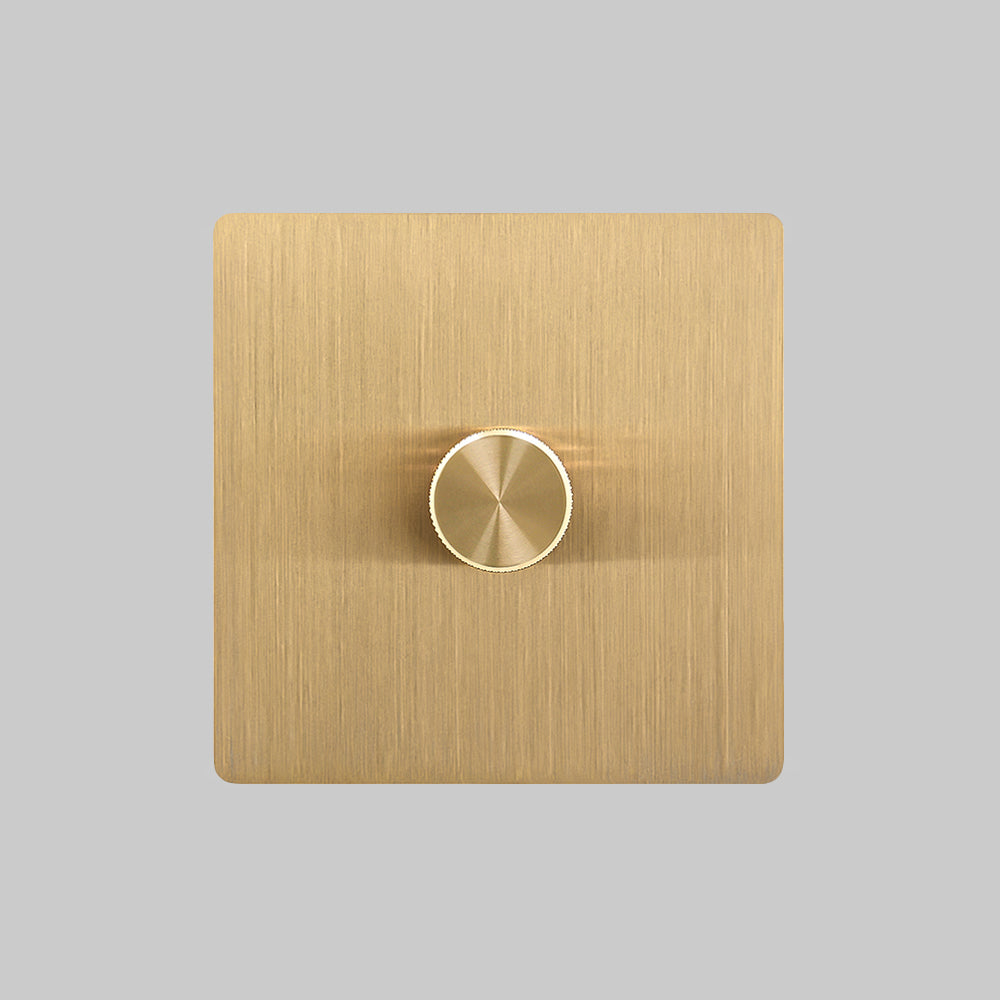
Check: Potentiometer
Potentiometers offer intuitive rotary control, smooth 0–100% dimming, and compatibility with UK back boxes (≥25mm depth). They require no neutral wire in many designs, making them perfect for older UK properties with traditional two-way switching. Their simplicity and reliability make them the preferred choice for premium dimmer installations across the UK market.
UK homeowners and trade professionals favour potentiometer-based rotary dimmers for several practical reasons. First, the rotary interface is familiar and intuitive—turning a knob to adjust brightness is a natural gesture that requires no learning curve. Unlike toggle switches or touch panels that offer limited feedback, a rotary knob provides tactile, continuous control, allowing users to fine-tune brightness precisely.
Second, potentiometer dimmers integrate seamlessly into traditional UK electrical infrastructure. Many UK properties, particularly Victorian terraces and period homes, were wired without neutral conductors in switch circuits—only live, earth, and switch wires. Standard dimmers require a neutral connection, making them impossible to install in these homes without expensive rewiring. Repenic's no-neutral dimmer designs solve this problem by using advanced electronic circuits that work with live-only switching, fitting standard ≥25mm back boxes without modification.
Third, potentiometer dimmers deliver flicker-free performance across all light types. Repenic's Dimmer Switch series (available in Solid Brass, Black Steel, and White Steel finishes) supports LED, halogen, and incandescent loads from 5–250W (or up to 400W in higher-capacity models) with programmable trailing or leading edge dimming modes. This flexibility ensures compatibility with modern LED bulbs—a critical requirement, as many budget dimmers cause LED flicker or fail to dim LEDs below 20% brightness.
Fourth, the premium materials used in Repenic potentiometer dimmers—100% solid brushed brass or stainless steel faceplates with knurled metal knobs—ensure long-term reliability and aesthetic consistency. These materials resist tarnishing and wear, maintaining their appearance and tactile quality for decades. This durability is especially valued in period renovations where maintaining authentic design details is important.
What Is Trailing Edge vs Leading Edge Dimming in Potentiometer Dimmers?
Trailing edge dimming (default in Repenic models) cuts power at the end of each AC cycle, ideal for LEDs and modern electronics. Leading edge dimming cuts power at the start of the cycle, better for incandescent and halogen loads. Repenic potentiometer dimmers are programmable, allowing you to select the mode that best suits your specific light bulbs and circuit requirements.
Both trailing and leading edge dimming work by controlling when power is delivered during each cycle of the 50Hz AC mains supply (standard in UK homes). Each cycle lasts 20 milliseconds and consists of a rising and falling sine wave. The dimming mode determines which part of this wave is cut off.
Trailing Edge Dimming: This mode cuts power at the end (trailing edge) of each AC cycle. The light receives full power for the first portion of the cycle, then the dimmer switches off abruptly. As you increase the dimming level, the "on" portion of the cycle becomes shorter, reducing the average power delivered and dimming the light. Trailing edge is gentler on electronic components and is the default setting in Repenic dimmers because it works reliably with dimmable LEDs, which contain sensitive electronic drivers. It also produces less electromagnetic interference and is quieter than leading edge.
Leading Edge Dimming: This mode cuts power at the start (leading edge) of each AC cycle. The dimmer switches off immediately as the cycle begins, then switches back on partway through. Leading edge creates a steeper voltage rise, which is more compatible with traditional incandescent and halogen filaments. However, it can cause flickering or buzzing in LED circuits and is more prone to electromagnetic noise.
Repenic's programmable potentiometer dimmers allow you to select either mode via the product configuration, ensuring optimal performance for your specific lighting setup. If you're upgrading an older home with a mix of incandescent and LED fixtures, you can choose trailing edge (default) for modern LED compatibility, or switch to leading edge if your circuit is primarily halogen or incandescent.
How Do No-Neutral Potentiometer Dimmers Fit UK Back Boxes?

Repenic no-neutral potentiometer dimmers use advanced electronic circuits that operate without a neutral wire connection, fitting standard UK back boxes (≥25mm depth). This design eliminates the need for rewiring older homes, allowing you to upgrade lighting control while preserving existing switch circuits and wall boxes.
Traditional dimmer switches require three connections: live, neutral, and earth. The neutral wire allows the dimmer's electronic control circuit to operate continuously, even when the switch is off, enabling remote control and smart features. However, many UK properties built before the 1980s have only two wires in switch circuits: live and earth (no neutral). This is a significant installation barrier for homeowners wanting to upgrade to smart or advanced dimmers.
Repenic's potentiometer dimmers overcome this limitation through innovative circuit design. By carefully managing how current flows through the light load itself, these dimmers can operate without a dedicated neutral connection. The light fixture acts as a partial return path for current, allowing the dimmer's internal electronics to function. This no-neutral capability is a game-changer for UK renovations, as it eliminates the need for expensive rewiring or back-box modifications.
All Repenic potentiometer dimmers are designed to fit standard UK back boxes with a minimum depth of 25mm. The module housing is compact and uses recycled PC plastic, keeping the overall profile narrow—especially important in multi-gang installations where space is tight. The solid brass or stainless steel faceplate sits flush with your wall, providing a seamless, professional appearance that matches period aesthetics or modern interiors.
Installation is straightforward: simply connect the live wire to the "L" terminal, the switched live (output to the light) to the "L2" terminal, and earth to the earth terminal. No neutral wire is required. The dimmer fits into your existing back box without modification, and the rotary knob and faceplate finish (brass, steel, or white) can be chosen to match your décor.
Can Potentiometer Dimmers Handle LED Loads Without Flickering?
Yes. Repenic potentiometer dimmers use high-speed chipsets and tuned MOSFETs with programmable trailing edge dimming (default) and BOOST mode to deliver flicker-free LED dimming from 5–250W (or 400W). The BOOST mode automatically increases voltage at low brightness levels, ensuring LEDs illuminate reliably even at 1–10% brightness.
LED dimming is notoriously challenging because LED bulbs contain electronic drivers that expect a stable voltage supply. When older potentiometer dimmers try to reduce power to an LED, the driver may not receive enough voltage to operate, causing the LED to flicker, strobe, or fail to dim below a certain threshold (often 30–50%). This frustration is why many UK homeowners avoid upgrading to dimmers when switching to LED lighting.
Repenic's solution combines three technologies to achieve flicker-free LED dimming:
1. High-Speed Chipset and Tuned MOSFETs: The internal electronic control circuit samples the potentiometer position and the AC mains voltage thousands of times per second. It then modulates the AC waveform with precision, delivering the exact voltage and current profile the LED driver expects. This rapid switching (far faster than the human eye can detect) creates smooth, imperceptible dimming without flicker or buzz.
2. Programmable Trailing Edge Dimming: By default, Repenic dimmers operate in trailing edge mode, which is the most compatible with LED drivers. This mode maintains a stable voltage rise at the start of each AC cycle, giving the LED driver the clean power signal it needs to function reliably across the full dimming range.
3. BOOST Mode: This intelligent feature detects when an LED is struggling to illuminate at very low brightness levels (below 5–10%). When activated, BOOST automatically increases the output voltage during the dim phase, ensuring the LED driver receives enough power to turn on. Once the light is on, the dimmer reduces voltage smoothly to achieve the desired low brightness. This prevents the "dead zone" where LEDs won't respond to dimming commands.
| Feature | Repenic Potentiometer Dimmer (Standard) | Repenic Potentiometer Dimmer (with BOOST) |
|---|---|---|
| LED Compatibility | 5–250W dimmable LED (R,C) | 5–250W dimmable LED (R,C) |
| Halogen Compatibility | 5–250W | 5–250W |
| Incandescent Compatibility | 5–250W | 5–250W |
| Dimming Range | 0–100% | 0–100% with low-level boost |
| Flicker Performance | Silent, real-time stability | Improved low-level stability |
| Minimum Brightness Setting | Programmable 1–50% | Programmable 1–50% (more reliable) |
In practice, this means you can confidently install a Repenic potentiometer dimmer with modern dimmable LED bulbs, retrofit LED downlights, or mixed LED and halogen circuits without worrying about flicker, strobing, or compatibility issues. The dimmer's internal intelligence handles the complexity, leaving you with smooth, reliable brightness control.
How Does Multi-Way Switching Work with Potentiometer Dimmers?
Multi-way potentiometer dimming uses a primary dimmer (like Repenic's RD-250) paired with dummy dimmers or multiway dimmers (RD-MP) on the same circuit. This allows you to control the same light from multiple locations—a hallway, landing, and bedroom, for example—with all switches offering full dimming capability or on/off control.
Traditional two-way switching (common in UK homes) uses two switches to control one light from two locations. A three-way or multi-way system extends this to three or more locations. The challenge with adding dimming to multi-way circuits is that standard potentiometer dimmers can only be installed at one location; the other switches must be either on/off only or non-functional dummies.
Repenic solves this with two approaches:
Approach 1: Primary Dimmer + Dummy Switches
Install a Repenic potentiometer dimmer (like the Dimmer Switch – Solid Brass or Black Steel series) at one location as the primary control. At other locations, install Repenic Dummy Dimmers (available in brass or steel, matching the primary dimmer's finish). The dummy dimmers look identical to the primary dimmer—same rotary knob, same premium faceplate—but function as simple on/off switches. This preserves the aesthetic consistency of your installation while providing dimming control at the primary location and on/off convenience at secondary locations.
Approach 2: Multiway Dimmers (RD-MP)
For installations where you want full dimming control from multiple locations, Repenic's Multiway Dimmer (RD-MP) is the solution. Up to five RD-MP units can be installed on the same circuit, each offering independent dimming control. All units communicate via the circuit wiring, so adjusting brightness at any location updates the light instantly. This is ideal for larger homes or commercial spaces where multiple people need independent dimming access.
The RD-MP operates on the same potentiometer principle as the standard dimmer but with added synchronisation logic. When you turn one knob, the electronics ensure all connected multiway dimmers reflect that brightness level. This creates a seamless, intuitive multi-location dimming experience.
Compatibility Notes: On the same circuit, you can use a maximum of one smart dimmer (like the Zigbee RD-250ZG) plus up to two multiway dimmers (RD-MP). Standard on/off switches or intermediate switches cannot be mixed with potentiometer dimmers on the same circuit—only Repenic multiway or dummy dimmers are compatible. This ensures electrical safety and reliable operation.
Why Choose Repenic Brass and Steel Potentiometer Dimmers for Renovations?
Repenic potentiometer dimmers in solid brass and stainless steel offer premium aesthetics, superior durability, UK-specific no-neutral design, and flicker-free LED performance. They fit standard back boxes, support multi-way circuits, and carry a 5-year warranty, making them the ideal choice for period renovations and modern upgrades alike.
When selecting potentiometer dimmers for a home renovation, material choice is as important as electrical performance. Repenic's commitment to premium finishes reflects a deeper philosophy: lighting control is not just functional—it's a design statement that should last decades and complement your home's character.
Solid Brass Dimmers: The Dimmer Switch – Solid Brass series features 100% solid brushed brass faceplates and knurled metal knobs. Brass is prized in period properties for its warm, authentic aesthetic that matches Victorian and Edwardian electrical fittings. Unlike plated finishes that can wear or tarnish, solid brass develops a natural patina over time, enhancing its character. The weight and tactile quality of brass knobs signal quality to anyone who uses the switch. For homeowners restoring period homes, solid brass Repenic dimmers are often the only option that maintains historical integrity while providing modern dimming performance.
Stainless Steel Dimmers: The Dimmer Switch – Black Steel and White Steel series use 100% solid brushed stainless steel faceplates and knurled metal knobs. Stainless steel is corrosion-resistant, hygienic, and suits contemporary or industrial-style interiors. It's also ideal for kitchens and bathrooms where moisture exposure might damage painted finishes. The brushed (matte) finish avoids fingerprints and reflects light subtly, creating a sophisticated appearance in modern homes.
Durability and Reliability: All Repenic potentiometer dimmers are built to last. The V0 fire-rated recycled plastic module housing, combined with premium metal faceplates, exceeds UKCA standards. Six layers of intelligent protection shield against surges, overloads, and thermal stress. The 5-year warranty reflects Repenic's confidence in product longevity—a reassurance that your investment in quality dimming control is protected.
UK-Specific Design: Repenic dimmers are engineered for UK homes. They fit standard ≥25mm back boxes without modification, require no neutral wire (solving the problem in older properties), and are compatible with all major UK grid systems (MK, BG, DETA, Hager, Hamilton, Crabtree, Schneider, Schneider-lisse, Wandsworth). This attention to local requirements means you can order with confidence, knowing the dimmer will work in your home without surprises or callbacks.
Multi-Way and Smart Integration: Repenic's potentiometer dimmers integrate seamlessly with multiway circuits and, if desired, smart home ecosystems. The Zigbee Smart Dimmer (RD-250ZG) in brass or steel finishes combines the familiar rotary control with smart features like energy monitoring, OTA (over-the-air) updates, sunrise and moonlight modes, and integration with platforms like Homey and Hubitat. This future-proofs your investment, allowing you to add smart automation without replacing existing hardware.
Repenic Expert Views
"Potentiometer-based rotary dimmers remain the gold standard for UK home lighting control because they combine intuitive tactile feedback with proven reliability. At Repenic, we've engineered our potentiometer dimmers to solve the real challenges UK homeowners face: older properties without neutral wires, mixed LED and halogen circuits, and the need for multi-way control in period homes. Our high-speed chipsets and tuned MOSFETs ensure flicker-free dimming across all load types, while our premium brass and steel finishes provide durability and aesthetic authenticity. Whether you're renovating a Victorian terrace or upgrading a modern flat, a Repenic potentiometer dimmer is an investment in reliable, beautiful lighting control that will serve your home for decades."
Conclusion
Potentiometer dimmer switches are the foundation of smooth, reliable brightness control in UK homes. By using a variable resistor to adjust voltage as a voltage divider, potentiometers enable intuitive rotary control that works seamlessly with LEDs, halogens, and incandescent bulbs. Repenic's potentiometer dimmers take this proven technology further, combining high-speed chipsets, tuned MOSFETs, and programmable trailing/leading edge modes to deliver flicker-free dimming from 0–100%. Their no-neutral design fits standard UK back boxes, making them ideal for period properties where rewiring is impractical. With premium brass and stainless steel finishes, multi-way compatibility, and a 5-year warranty, Repenic potentiometer dimmers offer the technical precision and aesthetic quality that UK homeowners and trade professionals demand.
Frequently Asked Questions
Do I need a neutral wire to install a Repenic potentiometer dimmer?
No. Repenic's potentiometer dimmers are designed to work without a neutral wire, making them perfect for older UK homes where only live and earth wires are present in switch circuits. The dimmer's internal electronics operate by using the light load as a partial return path for current. However, if a neutral wire is present in your back box, you can safely terminate it within the box without affecting dimmer performance.
Can I use a Repenic potentiometer dimmer with dimmable LED bulbs?
Yes. Repenic potentiometer dimmers support dimmable LED loads from 5–250W (or 400W in higher-capacity models) with flicker-free performance. The BOOST mode feature automatically increases voltage at low brightness levels, ensuring LEDs illuminate reliably even at 1–10% brightness. Always use bulbs marked "dimmable" for best results.
What's the difference between trailing edge and leading edge dimming?
Trailing edge dimming (default in Repenic models) cuts power at the end of each AC cycle and is gentler on LEDs and modern electronics. Leading edge dimming cuts power at the start of the cycle and is traditionally better for incandescent and halogen loads. Repenic dimmers are programmable, allowing you to select the mode that suits your specific bulbs and circuit.
Can I control the same light from multiple rooms using a Repenic potentiometer dimmer?
Yes. You can pair a primary Repenic potentiometer dimmer with Dummy Dimmers at other locations (providing on/off control), or install up to five Multiway Dimmers (RD-MP) on the same circuit for full dimming control from multiple locations. All units are available in matching brass or steel finishes for aesthetic consistency.
What back box depth do I need for a Repenic potentiometer dimmer?
Repenic potentiometer dimmers require a minimum back box depth of 25mm. Most standard UK back boxes meet this requirement. If you're unsure about your existing back box, consult a qualified electrician or check your installation documentation.