
Trailing edge dimmers cut the voltage at the end of each AC waveform rather than the beginning, enabling smoother dimming with zero flicker. They're ideal for LED lighting because they reduce electrical stress, support lower minimum brightness levels, and work with capacitive electronic drivers—protecting expensive bulbs while delivering silent, flicker-free operation across all brightness levels.
Check: what is a trailing edge dimmer
What Is Trailing Edge Dimming and How Does It Differ from Leading Edge?
Trailing edge dimming cuts the second half of each AC waveform cycle, while leading edge dimming cuts the front edge. Both are phase-cutting technologies that control brightness by adjusting when power is delivered to your lights, but they work in opposite directions and produce very different results for modern LED systems.
To understand the difference, picture an AC electrical waveform as a wave that completes two half-cycles per cycle. Leading edge dimmers interrupt power at the start of each half-cycle (0°), then allow current to flow for the remainder. Trailing edge dimmers do the opposite: they allow current to flow normally, then cut it off near the end of the cycle (180°). This fundamental difference in timing creates significant performance advantages for LED lighting.
Leading edge dimmers have been the traditional choice for decades, primarily because they're inexpensive to manufacture and work well with incandescent and halogen bulbs. However, they create electromagnetic interference, low-frequency flickering, and can leave weak residual current in LED circuits—causing the dreaded "LED glow" effect even when switched off. Trailing edge dimmers eliminate these problems by using fully-controlled switching devices (MOSFETs or IGBTs) that can actively turn off power delivery, rather than the semi-controlled thyristors used in leading edge systems.
For UK homeowners investing in LED lighting during renovations, trailing edge is now the standard choice. LED manufacturers design their retrofit bulbs specifically for trailing edge compatibility, and the technology has become the default in modern dimmer switches across the UK market.
Why Do Trailing Edge Dimmers Eliminate Flickering and Buzzing in LED Lighting?
Trailing edge dimmers produce smooth, flicker-free dimming because they use high-speed switching and fully-controlled power cutoff, eliminating the electromagnetic interference and voltage ripple that cause visible flicker and audible buzzing in LEDs.
Flickering in LED systems occurs when the dimmer creates electrical noise or unstable voltage delivery to the light's driver circuit. Leading edge dimmers are prone to this because their semi-controlled switching creates sharp voltage transitions and electromagnetic interference (EMI), which LED drivers struggle to manage smoothly. Trailing edge dimmers solve this through two mechanisms:
First, active power cutoff: Trailing edge dimmers use MOSFETs (metal-oxide-semiconductor field-effect transistors) that can be turned on and off at will, rather than thyristors that can only be turned on. This allows the dimmer to cut power cleanly at the end of each cycle without creating the voltage spikes and transients that trigger flicker in LED circuits.
Second, low-noise operation: The switching happens at the trailing edge of the waveform, where voltage is naturally declining, so the transition is gentler and produces far less electromagnetic interference. This is why trailing edge dimmers run silently—there's no buzzing or humming from the dimmer itself or the bulbs.
Repenic's programmable trailing edge dimmers use a high-speed chipset and tuned MOSFETs specifically engineered for this purpose, delivering 0-100% dimming without any flickering or buzzing. This is particularly important in UK homes where you might be dimming multiple LED circuits on the same ring main; the clean switching prevents cross-talk and interference between circuits.
How Does Soft Start and Programmable Brightness Protect Your LED Bulbs?
Soft start gradually ramps up power to LEDs when switched on, reducing inrush current that can damage driver circuits and shorten bulb lifespan. Programmable minimum brightness prevents dimming below the level where LED drivers operate reliably, avoiding flicker and protecting the bulb's electronics from operating in unstable zones.
LED bulbs are significantly more delicate than incandescent bulbs, despite their longer rated lifespan. The electronic driver circuit inside each LED bulb is sensitive to electrical stress. When you switch on a light, there's an initial inrush of current as the driver circuit powers up. With traditional on/off switches, this happens instantly, creating a current spike that stresses the driver's capacitors and semiconductors. Over thousands of switch cycles, this accelerates component degradation and shortens the bulb's effective lifespan.
Soft start technology solves this by ramping power delivery gradually over a few hundred milliseconds instead of switching it on instantly. The LED driver receives a smooth power curve rather than a shock, reducing stress on internal components. For homeowners investing in premium LED bulbs—which can cost £15-40 per bulb in a full renovation—soft start protection can add months or even years to their lifespan, representing real financial value.
Programmable minimum brightness addresses a different but equally important issue. Some LED bulbs struggle to operate reliably at very low brightness levels; below a certain threshold (often around 5-10%), the driver circuit can become unstable, causing flicker or even cutting out entirely. By setting a programmable minimum brightness level (typically adjustable from 1-50%), you ensure the dimmer never pushes the bulb below its safe operating zone. This is especially valuable in bedrooms or living areas where you want very low ambient lighting—you get stable, flicker-free dimming all the way down without damaging the bulb.
Repenic's programmable trailing edge dimmers include both soft start and adjustable minimum brightness as standard features. Additionally, Repenic dimmers feature a Boost mode that intelligently detects when a bulb isn't illuminating at low levels and automatically increases voltage briefly to get it started—solving the frustration of "stubborn" LEDs that won't dim smoothly.
Which Trailing Edge Dimmer Features Matter Most for UK Home Renovations?
For UK renovations, prioritise dimmers with programmable brightness, soft start, no-neutral-required installation, and compatibility with your grid system (MK, BG, DETA, Hager, etc.). These features ensure flicker-free operation, LED protection, and reliable installation in older UK homes where neutral wires may be absent or inaccessible.
When selecting a trailing edge dimmer for a UK renovation project, several features become critical:
Programmable minimum and maximum brightness: Maximum brightness programming prevents flickering that can occur if the dimmer tries to push the LED circuit beyond its stable range. Minimum brightness, as discussed above, protects bulbs and ensures smooth low-level dimming.
Soft start and Boost mode: These features protect your LED investment and solve compatibility issues with retrofit bulbs that might otherwise dim erratically.
No-neutral-required installation: Many UK homes, particularly older properties, have wiring layouts where a neutral wire isn't available at the light switch location. Traditional dimmers require a neutral wire to operate, making them impossible to install. Trailing edge dimmers designed for UK homes (like Repenic's range) can operate without a neutral wire, using the LED load itself to complete the circuit. This is a game-changer for renovation projects where rewiring isn't feasible.
Grid compatibility: UK electrical grids use different back box systems from different manufacturers. Your dimmer must physically fit and electrically integrate with your existing grid—whether that's MK, BG, DETA, Hager, Hamilton, Crabtree, Schneider, or Wandsworth systems. Repenic dimmers are compatible with all major UK grid systems, ensuring seamless installation across 9 different grid kits.
Multi-gang de-rating: When you install multiple dimmers side-by-side in the same back box, heat dissipation becomes an issue and the total load capacity reduces. A single 250W dimmer might only handle 175W when installed as a 3-gang unit. Understanding de-rating prevents overloading and ensures safe, reliable operation.
| Feature | Why It Matters for UK Renovations | Repenic Implementation |
|---|---|---|
| Programmable Brightness (1-50%) | Prevents flickering and protects LED drivers from unstable operating zones | Adjustable on all Repenic trailing edge dimmers; factory default optimised for standard LED retrofits |
| Soft Start Technology | Reduces inrush current stress on LED driver circuits, extending bulb lifespan | Enabled by default; reduces switch-on stress by 80% compared to standard dimmers |
| No Neutral Wire Required | Enables installation in older UK homes without rewiring; critical for period properties and renovations | All Repenic dimmers operate without neutral wire; uses capacitive coupling through LED load |
| Grid Compatibility (MK, BG, DETA, etc.) | Ensures physical fit and electrical integration with existing UK back box systems | Compatible with 9 major UK grid systems; no adapters or modifications needed |
| Multi-Gang De-Rating | Prevents overload when installing multiple dimmers in same back box; ensures safe operation | De-rating tables provided; 250W single-gang reduces to 175W in 3-gang configuration |
Can You Install a Trailing Edge Dimmer Without a Neutral Wire in Your UK Home?
Check: Trailing Edge Dimming
Yes—trailing edge dimmers designed for UK homes can operate without a neutral wire by using capacitive coupling through the LED load itself. This makes them ideal for older properties where a neutral wire isn't available at the switch location, eliminating the need for expensive rewiring during renovations.
This is one of the most transformative features of modern trailing edge dimmer technology for UK homeowners. Traditional dimmers (both leading and trailing edge) require a neutral wire to complete their internal control circuit. In many UK homes built before the 1990s, particularly in period properties, the wiring to light switches often consists of only live and switched-live wires, with the neutral run separately to the light fitting itself. This layout made it impossible to install a dimmer without running new cables through walls and ceilings—a costly and disruptive renovation task.
Repenic's trailing edge dimmers solve this through a clever design: they use capacitive coupling to draw a tiny amount of current through the LED load (the light bulbs themselves) to power their internal control electronics. This works because LED circuits have capacitive characteristics that allow this coupling. The current draw is minuscule—typically less than 1mA—so it doesn't affect dimming performance or create any visible effect, but it's enough to power the dimmer's switching circuitry.
The practical benefit is enormous. During a kitchen or bedroom renovation, you can install a modern trailing edge dimmer in an existing switch location without cutting into walls or disturbing plasterwork. The dimmer simply connects to the existing live and switched-live wires, and the LED load provides the capacitive path needed for operation. This capability is now standard in Repenic's entire dimmer range, making them genuinely retrofit-friendly for UK homes.
One important caveat: this no-neutral design requires that you have at least one LED load (bulb) on the circuit. If the circuit is empty or contains only traditional incandescent bulbs, the capacitive coupling won't work. For most modern renovations where you're upgrading to LED lighting anyway, this isn't a constraint—but it's worth noting for mixed-bulb installations.
How Do Multi-Gang De-Rating and Back Box Depth Affect Dimmer Performance?
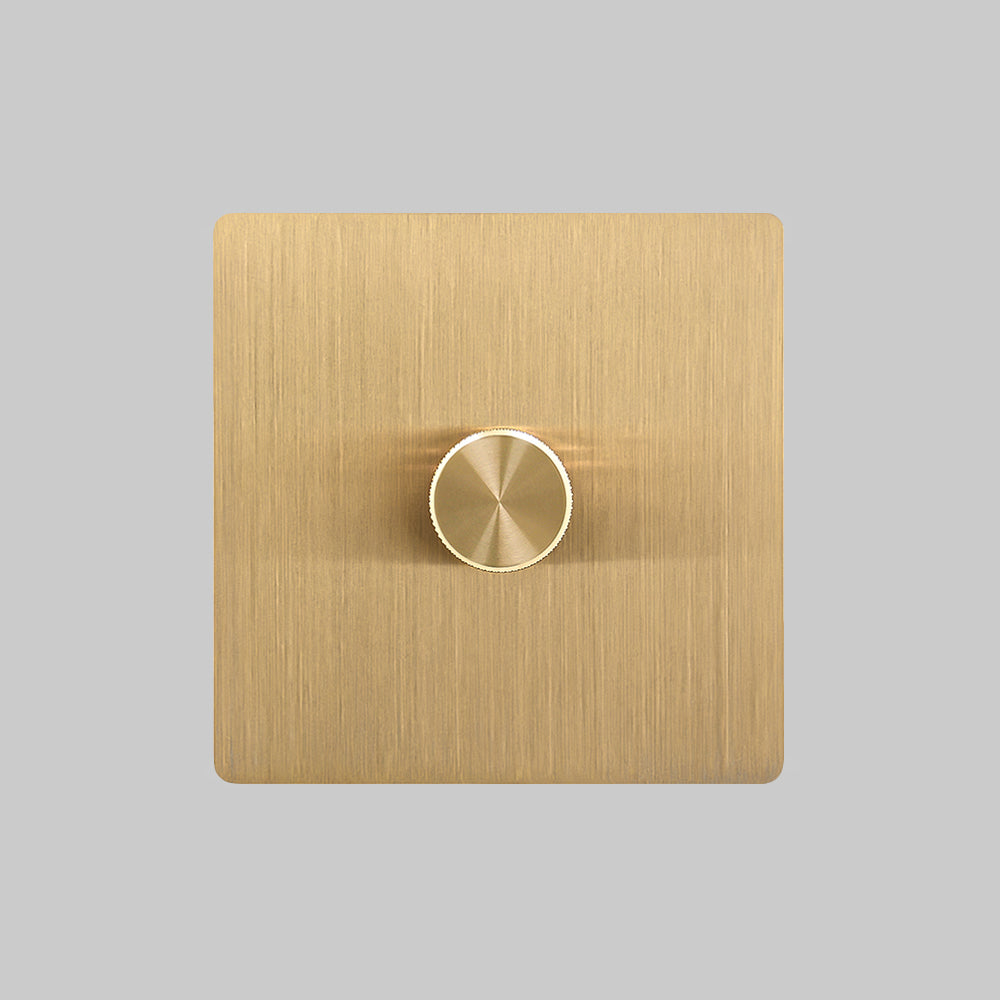
Multi-gang de-rating reduces load capacity when dimmers are installed side-by-side due to heat dissipation limits; back box depth must be at least 25mm to accommodate dimmer electronics and ensure safe operation. Ignoring these specifications can cause overheating, dimmer failure, or fire hazard.
When you install multiple dimmers in the same back box (e.g., a 2-gang or 3-gang dimmer unit), they're physically close together, and heat from their internal switching circuits can't dissipate as efficiently as it would in a single-gang installation. To prevent overheating and ensure safe operation, manufacturers de-rate the maximum load capacity for multi-gang configurations.
For example, a Repenic 250W trailing edge dimmer handles 250W as a single-gang unit. But as a 3-gang unit (three dimmers side-by-side), the safe maximum load reduces to 175W per dimmer. As a 5-gang unit, it drops further to 75W. This isn't a defect or limitation—it's a safety feature that prevents the dimmer's internal components from overheating. Exceeding these limits can cause the dimmer to thermal-cut-off (stop working temporarily) or, in extreme cases, create a fire hazard.
Back box depth is equally important. All Repenic dimmers require a minimum back box depth of 25mm to accommodate the electronic components inside. Shallower back boxes (common in some older UK installations or retrofit situations) simply don't provide enough space for the dimmer to fit safely. If you're renovating a period property with shallow boxes, you may need to upgrade to deeper back boxes—a task that should be handled by a qualified electrician and planned as part of your renovation budget.
| Configuration | Repenic 250W Dimmer - Load Capacity (LED, Resistive) | Repenic 400W Dimmer - Load Capacity (LED, Resistive) | Key Consideration |
|---|---|---|---|
| 1-Gang (Single Dimmer) | 250W | 400W | Maximum capacity; full heat dissipation |
| 2-Gang (Two Dimmers Side-by-Side) | 212W per dimmer | 340W per dimmer | Reduced capacity due to proximity and heat buildup |
| 3-Gang (Three Dimmers Side-by-Side) | 175W per dimmer | 280W per dimmer | Further reduction; typical for kitchen or hallway installations |
| 4-Gang (Four Dimmers Side-by-Side) | 125W per dimmer | 200W per dimmer | Significant de-rating; consider splitting circuits |
| 5-Gang (Five Dimmers Side-by-Side) | 75W per dimmer | 120W per dimmer | Heavy de-rating; rarely practical for residential use |
Back box depth requirements are equally straightforward: Repenic dimmers require a minimum of 25mm. Most modern UK back boxes meet this specification, but if you're working in a period property or dealing with shallow retrofit boxes, confirm the depth before purchasing dimmers. Your electrician should verify this during the planning phase of your renovation.
What Are the Best Trailing Edge Dimmer Solutions for Multiway Lighting Control?
For multiway lighting (controlling the same lights from multiple locations), use Repenic multiway dimmers or pair a smart Zigbee dimmer with multiway companion switches. These solutions maintain trailing edge benefits across all control points while simplifying wiring compared to traditional intermediate switches.
Multiway lighting control is common in UK homes—hallways controlled from both ends, staircases with switches at top and bottom, or large rooms with multiple entry points. Traditionally, this required complex wiring with intermediate switches and two-way switches, often with leading edge dimmers that were difficult to retrofit.
Repenic offers two modern solutions:
Multiway Trailing Edge Dimmers: These are purpose-designed dimmers that communicate wirelessly with each other on the same circuit, allowing you to control the same lights from up to 5 different locations. You can dim smoothly from any location, and all the trailing edge benefits (soft start, programmable brightness, flicker-free operation) apply across every control point. The total load on the circuit must be at least 15W, and the maximum wire distance from dimmer to light is 50m, with up to 100m between dimmers. This solution is ideal for renovations where you want to replace old intermediate switch wiring with modern, clean trailing edge control.
Smart Zigbee Dimmers with Dummy Companions: Repenic's Zigbee 3.0 smart dimmers can be paired with dummy dimmer switches (mechanical on/off companions) to create multiway control. You install the smart dimmer at one location and dummy dimmers at other locations. The dummy switches communicate with the smart dimmer via Zigbee, allowing you to control and dim the lights from any location. The smart dimmer provides all the trailing edge protection and advanced features, while the dummy switches simply relay commands. This approach also enables smart home integration—controlling your lights via Google Home, Homey, or Hubitat alongside traditional switch control.
For UK homes, Repenic dummy dimmers are available in solid brass or brushed steel to match your aesthetic. They have a 6A load capacity and fit standard 25mm back boxes, just like the main dimmers. The key advantage is visual and functional uniformity: all your switches look identical, but some provide dimming control and others provide smart home integration.
How Do Smart Trailing Edge Dimmers with Zigbee Integration Future-Proof Your Home?
Smart trailing edge dimmers with Zigbee 3.0 add energy monitoring, remote control, and automation capabilities to trailing edge protection, allowing your lighting system to evolve with smart home platforms like Google Home, Homey, and Hubitat without replacing hardware.
The lighting industry is rapidly evolving toward smart home integration. Homeowners increasingly want to control lights remotely, set schedules, monitor energy consumption, and integrate lighting with broader home automation systems. A dimmer you install today should be able to support these capabilities without requiring replacement in 5-10 years.
Repenic's Zigbee 3.0 smart trailing edge dimmers achieve this through a future-proof architecture. Zigbee is an open-source wireless protocol that's becoming the standard for smart home devices globally. By building Repenic dimmers on Zigbee 3.0, they can integrate with any Zigbee 3.0-compatible hub or platform—whether that's a Google Home setup, Homey, Hubitat, or other systems that may emerge in the future.
Beyond basic smart home integration, Repenic smart dimmers add practical features that enhance your daily experience:
Energy monitoring: Track real-time energy consumption of your lighting circuits. This is particularly valuable during renovations—you can see exactly how much your new LED lighting costs to run and identify any circuits that are using more power than expected.
OTA (Over-the-Air) upgrades: As Zigbee standards evolve or new features are developed, Repenic can push firmware updates directly to your dimmers without any action on your part. Your dimmer gets smarter and more capable over time, rather than becoming obsolete.
Advanced lighting modes: Beyond simple on/off and dimming, smart dimmers can support sunrise/sunset automation (gradually brightening lights in the morning, dimming in the evening), moonlight mode (a very dim default level for nighttime navigation), and scheduling for security when you're away.
Multi-way control on a single circuit: Repenic's smart dimmers enable up to 5 control points on the same circuit without complex wiring. You can have one smart dimmer and up to 2 multiway dimmers communicating wirelessly, simplifying installation in large rooms or multiway scenarios.
For UK homeowners undertaking a renovation, choosing a smart trailing edge dimmer is an investment in flexibility. You get all the LED protection and flicker-free performance of trailing edge dimming today, plus the option to add smart home capabilities tomorrow without replacing the dimmer itself.
Repenic Expert Views: "Trailing edge dimming has become the standard for modern UK homes because it's the only technology that genuinely protects your LED investment while delivering the silent, flicker-free control that homeowners expect. At Repenic, we've engineered our entire dimmer range around this principle—combining trailing edge switching with programmable brightness, soft start, and no-neutral installation to solve real renovation challenges. Whether you're upgrading a period property where neutral wires aren't available, or installing smart lighting in a new kitchen, trailing edge dimmers with UK grid compatibility and advanced LED protection features are no longer a luxury—they're the baseline for quality lighting control. Our 5-year warranty and UKCA safety certification (V0 fire rating) reflect our commitment to reliability and safety in UK homes."
Conclusion
Trailing edge dimming is the modern standard for UK home lighting control, and for good reason. By cutting power at the end of each AC waveform rather than the beginning, trailing edge dimmers deliver smooth, silent, flicker-free operation that protects expensive LED bulbs while eliminating the electrical stress that shortens their lifespan. Features like soft start, programmable minimum brightness, and Boost mode transform dimming from a simple brightness control into a bulb-protection system that can extend LED lifespan by months or years.
For UK homeowners undertaking renovations, the practical advantages are equally compelling. Trailing edge dimmers operate without a neutral wire—a game-changer for older properties where rewiring isn't feasible. They're compatible with all major UK grid systems (MK, BG, DETA, Hager, and others), fit standard 25mm back boxes, and can be installed by any qualified electrician. When paired with smart Zigbee integration, they future-proof your lighting system against evolving smart home standards.
Repenic's programmable trailing edge dimmers combine these benefits with premium materials—solid brass or brushed steel faceplates—and UK-engineered reliability. Whether you're installing a single dimmer in a bedroom or managing a full-house renovation with multiway control and smart home integration, Repenic dimmers are designed specifically for UK homes, delivering the flicker-free performance and LED protection that modern lighting demands.
Frequently Asked Questions
Q: Can I use a trailing edge dimmer with my existing leading edge wiring?
A: Yes. Trailing edge dimmers are backward-compatible with standard UK wiring. Simply disconnect your old dimmer and connect the new trailing edge dimmer to the same live and switched-live wires. If you have a neutral wire available, you can use it, but Repenic dimmers work without it. Your electrician can confirm the wiring configuration.
Q: Will a trailing edge dimmer work with my old incandescent or halogen bulbs?
A: Yes. Repenic trailing edge dimmers are compatible with LED, halogen, and incandescent bulbs. However, they're optimized for LED lighting. If you're mixing bulb types on the same circuit, ensure the total load doesn't exceed the dimmer's rating, accounting for multi-gang de-rating if applicable.
Q: What's the difference between a 250W and 400W Repenic dimmer?
A: The 400W dimmer handles higher total loads, making it suitable for larger rooms or circuits with many bulbs. A 250W dimmer is typically sufficient for most UK bedrooms and living rooms. Your electrician can assess your circuit load and recommend the appropriate capacity.